Electronics & Communication Gate Yearwise
Electronics and Communication Gate 2016 Set-1 Questions with Answer
Ques 53 GATE 2016 SET-1
In an 8085 system, a PUSH operation requires more clock cycles than a POP operation. Which one of the following options is the correct reason for this?
Ques 54 GATE 2016 SET-1
Consider a two-port network with the transmission matrix: T=[[A,B],[C,D]]. If the network is reciprocal, then
Ques 55 GATE 2016 SET-1
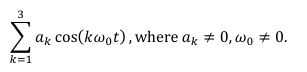
A network consisting of a finite number of linear resistor (R), inductor (L), and capacitor (C) elements, connected all in series or all in parallel, is excited with a source of the form
Ques 56 GATE 2016 SET-1
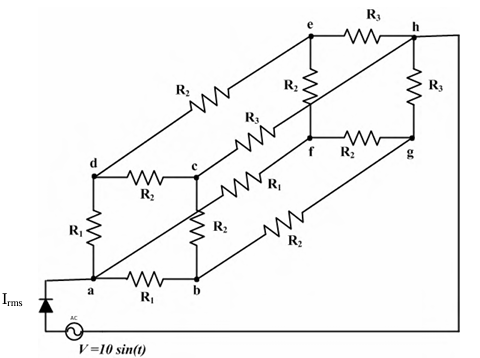
An AC voltage source V=10sin(t) volts is applied to the following network. Assume that R1=3 Ω, R2=6 Ω and R3=∞Ω, and that the diode is ideal.
Ques 57 GATE 2016 SET-1
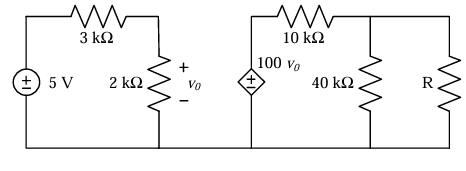
In the circuit shown in the figure, the maximum power (in watt) delivered to the resistor R is
Ques 58 GATE 2016 SET-1
The second moment of a Poisson-distributed random variable is 2. The mean of the random variable is
Ques 59 GATE 2016 SET-1
Which one of the following is an eigen function of the class of all continuous-time, linear, time-invariant systems (u(t) denotes the unit-step function)?
Ques 60 GATE 2016 SET-1
A continuous-time function x(t) is periodic with period T. The function is sampled uniformly with a sampling period TS. In which one of the following cases is the sampled signal periodic?
Ques 61 GATE 2016 SET-1
Consider the sequence x[n]=anu[n]+bnu[n], where u[n] denotes the unit-step sequence and 0<|a|<|b|<1. The region of convergence (ROC) of the z-transform of x[n] is
Ques 62 GATE 2016 SET-1
A continuous-time sinusoid of frequency 33 Hz is multiplied with a periodic Dirac impulse train of frequency 46 Hz. The resulting signal is passed through an ideal analog low-pass filter with a cutoff frequency of 23 Hz. The fundamental frequency (in Hz) of the output is
Ques 63 GATE 2016 SET-1
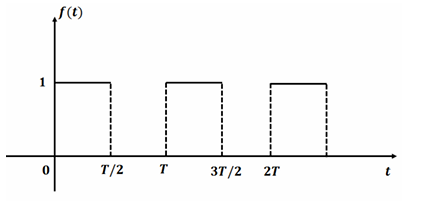
The Laplace transform of the causal periodic square wave of period T shown in the figure below is
Ques 64 GATE 2016 SET-1
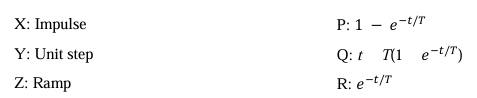
A first-order low-pass filter of time constant T is excited with different input signals (with zero initial conditions up to t=0). Match the excitation signals X, Y, Z with the corresponding time responses for t≥0:
Ques 65 GATE 2016 SET-1
Consider the signal. x[n]=6δ[n+2]+3δ[n+1]+8δ[n]+7δ[n-1]+4δ[n-2]. If X(ejω) is the discrete-time Fourier transform of x[n], then (1/π)∫-ππX(ejω)sin2(2ω)dω is equal to

Total Unique Visitors