Electronics & Communication Gate Yearwise
Electronics and Communication Gate 2026 Questions with Answer
Ques 1 GATE 2026
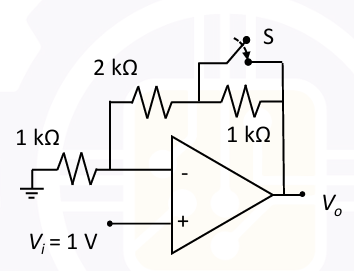
The ideal OP-AMP circuit shown in the Figure produces output voltage Vo = x when the Switch, S, is open.
Which of the options represents the output voltage when S is closed?
Ques 2 GATE 2026
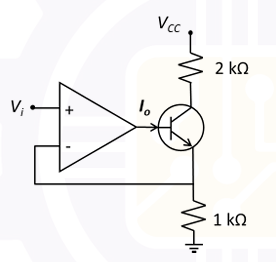
Consider the circuit shown in the Figure with Vi = 3 V and VCC = 12 V.
Assume VBE = 0.7 V and βdc = 99 for the BJT.
Which of the following options is the correct value of the current Io?
Ques 3 GATE 2026
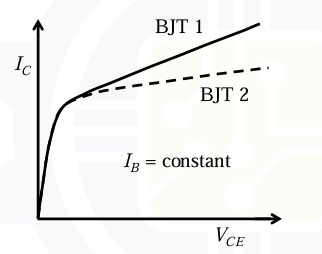
Figure shows the output characteristics of two different Bipolar Junction Transistors (BJT), BJT 1 with magnitude of Early voltage |VA1|, and BJT 2 with magnitude of Early voltage |VA2|.
Ques 4 GATE 2026
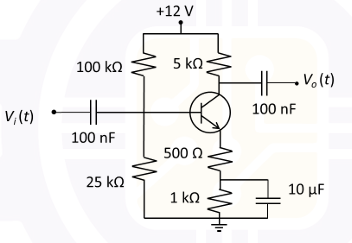
A small signal source, Vi(t) = A cos(105t) + B sin(107t) is applied to a BJT circuit as shown in the Figure.
Assume zero source resistance, VBE = 0.7 V, βdc = 99, Early voltage = 100 V and Thermal voltage = 25 mV. Effect of internal parasitic capacitances of the BJT may be neglected.
Which expression is the best approximation of the output voltage Vo(t)?
Ques 5 GATE 2026
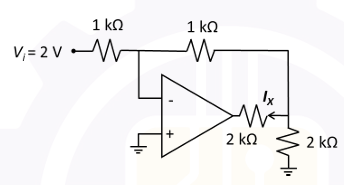
A circuit using an ideal OP-AMP is shown in the Figure.
Which of the following options gives the correct value of the current IX?
Ques 6 GATE 2026
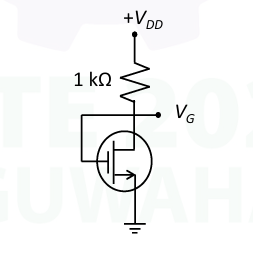
An n-channel MOSFET is connected as shown in the Figure.
Assume VTH = 1 V, VDD = 5 V, and μCox(W/L) = 2 mA V−2 and neglect channel length modulation effects.
The gate voltage (VG) of the n-channel MOSFET (in Volt) is __.
(rounded off to two decimal places)
Ques 7 GATE 2026
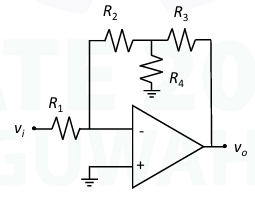
Consider an ideal OP-AMP circuit as shown in the Figure.
The resistances R1 = R2 = R3 = R4 = 50 kΩ.
The magnitude of the closed loop gain is ___.
(rounded off to two decimal places)
Ques 8 GATE 2026
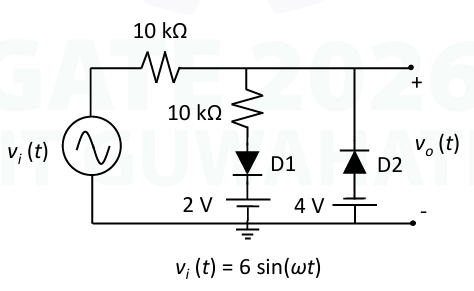
Consider the ideal diodes D1 and D2 as shown in the Figure with cut-in voltage Vγ = 0 Volt and vi(t) is in Volt.
The maximum voltage (Volt) of the output vo(t) is __.
(rounded off to two decimal places)
Ques 9 GATE 2026
Consider the Friis’ transmission equation PR = (PTGTGRλ2)/(4πD)2, where PR and PT are the received and the transmitted powers, respectively.
GT and GR are the gain of transmitting and receiving antennas, respectively, D is the distance between the transmitting and receiving antennas, and λ is the wavelength in free space.
Given: GT = GR = 1.0, λ = 0.30 m and PT = +10 dBm.
Choose the distance (D), in km, from the following options at which the received power, PR = −90 dBm?
Ques 10 GATE 2026
Consider a discrete memoryless source with an alphabet of four source symbols.
s(t) is a multi-level (-1, 0, +1, +2) signal representing a long sequence of random symbols from the above source which is generating 104 symbols per second.
Which of the following options is the correct value of equivalent Nyquist bandwidth of s(t)?
Ques 11 GATE 2026
A wireless digital transmission scheme is using 16-QAM over an additive white Gaussian noise channel and a maximum-likelihood receiver. Consider the information bit rate from source to be 4 × 106 bits per second.
The minimum transmission bandwidth (in MHz) of the modulated signal necessary for optimum recovery of information at the receiver is __.
(rounded off to two decimal places)
Ques 12 GATE 2026
A QPSK modulated signal from an additive white Gaussian noise (AWGN) channel is received with an Eb/No = 8.4 dB at the input of a coherent QPSK demodulator. A maximum-likelihood reception method is used in the demodulator.
Assume the complimentary error function erfc(u) ≅ [1/(u√π)]exp(−u2).
Which is the nearest bit error rate (BER) at the output of the demodulator?
Ques 13 GATE 2026
Let the relevant bandwidth (B) of a digital communication system be 1 MHz and kT = −174 dBm/Hz, where k is Boltzmann’s constant and ‘T’ is equivalent noise temperature of the receiver. The power (S) of signal received through an additive Gaussian channel is −80 dBm.
Which of the following options is/are TRUE about Shannon capacity (C) of the channel?

Total Unique Visitors