Civil Engineering Gate Yearwise
Civil Gate 2026 Set-2
Civil Gate 2025 Set-1
Civil Gate 2025 Set-2
Civil Gate 2024 Set-1
Civil Gate 2024 Set-2
Civil Gate 2023 Set-1
Civil Gate 2023 Set-2
Civil Gate 2022 Set-1
Civil Gate 2022 Set-2
Civil Gate 2021 Set-1
Civil Gate 2021 Set-2
Civil Gate 2020 Set-1
Civil Gate 2020 Set-2
Civil Gate 2019 Set-1
Civil Gate 2019 Set-2
Civil Gate 2018 Set-1
Civil Gate 2018 Set-2
Civil Gate 2017 Set-1
Civil Gate 2017 Set-2
Civil Gate 2016 Set-1
Civil Gate 2016 Set-2
Civil Gate 2015 Set-1
Civil Gate 2015 Set-2
Civil Gate 2014 Set-1
Civil Gate 2014 Set-2
Civil Gate 2013
Civil Engineering Gate 2026 Set-1 Questions with Answer
Ques 40 GATE 2026 SET-1
A 30 m long tape is standardized at 25°C. It was used to measure the length of a line which came out to be 200 m. The temperature during the measurement was 35°C. The coefficient of expansion of the tape was 11 × 10−6 per °C. The correction in the measured length (in mm) due to change in temperature is ______ (in integer).
The temperature correction in tape measurement accounts for the expansion or contraction of the tape relative to its standardisation temperature. The correction formula is:
Ct = α × (T − T₀) × L
where α is the coefficient of expansion, T is the field temperature, T₀ is the standardisation temperature, and L is the measured length.
Substituting values:
Ct = 11 × 10⁻⁶ × (35 − 25) × 200 = 11 × 10⁻⁶ × 10 × 200 = 0.022 m = 22 mm
Since the field temperature (35°C) is higher than the standardisation temperature (25°C), the tape has expanded, meaning the actual length measured is slightly more than what the tape readings suggest — this is a positive correction that must be added to the measured length to get the true distance.
Correct answer: 22 mm ✓
Ques 41 GATE 2026 SET-1
The height of the plane of collimation of a levelling instrument is 100.000 m from a datum. The levelling instrument measures a Back Sight of 1.500 m on a vertically held staff at a ground point P. The reduced level (in m) of the ground point P with respect to the datum is ________________ (rounded off to three decimal places).
In the Height of Instrument (HI) method of levelling, the reduced level of any point is found by subtracting the staff reading from the height of the plane of collimation (HI), since the staff reading represents the vertical distance below the line of sight at that point.
RL of P = HI − BS = 100.000 − 1.500 = 98.500 m
Correct answer: 98.500 ✓
Ques 42 GATE 2026 SET-1
Locations P and Q are separated by a wide valley. The difference in levels of locations P and Q measured by a levelling instrument stationed near P is 3.0 m. The same instrument stationed near Q measures the difference in levels of locations P and Q as −1.0 m. Assume that the atmospheric refraction is same during the measurements. The true difference in levels (in m) of locations P and Q is
In reciprocal levelling across a wide valley, both observations are affected by the combined error due to earth''s curvature and atmospheric refraction. Let h be the true difference in level (Q − P) and e be the combined error. Since refraction is the same for both observations and the distance PQ is the same, e is identical for both.
When the instrument is stationed near P, the error e makes Q appear higher than its true level:
Observed (Q − P) = h + e = 3.0 m ... (i)
When the instrument is stationed near Q, the same error e makes P appear higher, so Q appears lower:
Observed (Q − P) = h − e = −1.0 m ... (ii)
Adding both equations:
2h = 3.0 + (−1.0) = 2.0
h = 1.0 m (Q is 1.0 m above P)
This is the standard reciprocal levelling formula: true difference = average of the two observed differences = (3.0 + (−1.0))/2 = 1.0 m ✓
Correct answer: A — 1.0 m ✓
Ques 43 GATE 2026 SET-1
An infinite slope with slope angle β = 22° consists of soil with the following properties:
Unit weight γ = 15.72 kN/m3
Cohesion c′ = 12 kPa
Angle of internal friction φ′ = 15°
The critical height of the slope (in m) is ______ (rounded off to two decimal places).
The critical height of a slope is the maximum height at which the slope remains stable (Factor of Safety = 1). For a cohesive frictional soil, this is determined using Taylor''s stability chart.
The stability number Ns is obtained from Taylor''s chart for slope angle β = 22° and angle of friction φ′ = 15°. For these values, Ns ≈ 6.83.
The critical height is then:
Hc = Ns × c′/γ
Hc = 6.83 × 12/15.72
Hc = 81.96/15.72
Hc = 5.21 m
Taylor''s stability chart is the standard method for determining critical heights of slopes in cohesive frictional soils, where both cohesion and friction contribute to stability. The critical height decreases as the slope angle increases or as soil strength decreases.
Correct answer: 5.21 m ✓
Ques 44 GATE 2026 SET-1
A circular pile of 600 mm diameter and 6 m length is embedded in a saturated clayey soil. Undrained cohesion of the soil is 80 kPa. Unit weight of the soil is 19.20 kN/m3. The adhesion factor is 0.54. If the diameter of the pile is doubled to 1200 mm (keeping the length constant), the ratio of pile capacity of 1200 mm diameter pile to that of 600 mm diameter pile is ______ (rounded off to two decimal places).
For a friction pile in clay, the pile capacity is governed by skin friction:
Q = α × c × π × d × L
The capacity is directly proportional to the pile diameter d through the perimeter term π × d. All other parameters — adhesion factor α, undrained cohesion c, and length L — remain unchanged when only the diameter is doubled.
For d₁ = 600 mm = 0.6 m:
Q₁ = 0.54 × 80 × π × 0.6 × 6 = 488.1 kN
For d₂ = 1200 mm = 1.2 m:
Q₂ = 0.54 × 80 × π × 1.2 × 6 = 976.2 kN
Ratio = Q₂/Q₁ = 1.2/0.6 = 2.00
The unit weight (19.20 kN/m³) given in the question is not needed for this calculation — end bearing is not considered for this friction pile problem, and the ratio depends only on the ratio of diameters.
Correct answer: 2.00 ✓
Ques 45 GATE 2026 SET-1
A group of 25 circular piles is arranged in 5 × 5 uniform pattern in a soft clay soil with equal spacing in both the directions. These are friction piles with negligible end bearing.
Consider the following details:
Diameter of each pile = 1 m
Length of each pile = 15 m
Cohesion of the soil = 20 kN/m2
Unit weight of the soil = 16 kN/m3
Adhesion factor = 0.75
Considering the efficiency of the pile group as unity, the optimum value of the ratio of the pile spacing to pile diameter is __________________ (rounded off to one decimal place).
The optimum s/d ratio is found by equating the group block failure capacity to the sum of individual pile capacities (efficiency = 1).
Individual pile capacity (25 piles):
Qsingle = α × c × π × d × L = 0.75 × 20 × π × 1 × 15 = 706.86 kN
Qtotal = 25 × 706.86 = 17671.5 kN
Group block capacity:
Block side Bg = (5−1)s + d = 4s + 1
Qgroup = c × (perimeter × L) + Nc × c × Bg²
= 20 × 4(4s+1) × 15 + 5.14 × 20 × (4s+1)²
= 1200(4s+1) + 102.8(4s+1)²
Setting Qgroup = Qtotal:
Let x = 4s+1:
102.8x² + 1200x = 17671.5
Solving: x ≈ 8.51 → s ≈ 1.878 m → s/d ≈ 1.9 ≈ 2.0 (rounded to one decimal place)
Correct answer: 2.0 ✓
Ques 46 GATE 2026 SET-1
A shallow strip footing of width 2 m is embedded at a depth of 1.5 m below the ground surface in a homogeneous pure clay with an angle of internal friction zero. Consider unit weight of soil as 20 kN/m3 and undrained cohesion of soil as 20 kN/m2.
Due to rise of ground water table from far below the founding depth to the ground surface in monsoon season, the magnitude of percentage change in the net ultimate bearing capacity as per Terzaghi’s theory is __________________ (rounded off to two decimal places).
For a strip footing on pure clay (φ = 0) using Terzaghi''s theory with Nc = 5.7, Nq = 1, Nγ = 0:
GWT far below founding depth:
qu = 5.7c + γDf = 5.7 × 20 + 20 × 1.5 = 114 + 30 = 144 kN/m²
qnet,u = 144 − 30 = 114 kN/m²
GWT rises to ground surface:
Effective unit weight γ'' = γsat − γw = 20 − 10 = 10 kN/m²
Effective overburden q'' = γ'' × Df = 10 × 1.5 = 15 kN/m²
qu'' = 5.7c + q'' = 114 + 15 = 129 kN/m²
qnet,u'' = 129 − γDf = 129 − 30 = 99 kN/m²
Percentage change in net ultimate bearing capacity:
% change = (114 − 99)/114 × 100 = 15/114 × 100 = 13.16%
Ques 47 GATE 2026 SET-1
The name of a person in Column 1 is to be matched with the test mentioned in Column 2.
Column 1 Column 2
(I) Menard (P) Dilatometer test
(II) Marchetti (Q) Pressuremeter test
(III) Casagrande (R) Compaction test
(IV) Proctor (S) Liquid limit test
Option giving the CORRECT match between Column 1 and Column 2 is:
Ques 48 GATE 2026 SET-1
For a liquid, the permeability of a sandy soil having a void ratio of 0.60 was determined as 0.14 cm/s. Considering the same liquid and by using Taylor’s equation, the permeability (in cm/s) of this soil corresponding to the void ratio of 0.80 is _____ (rounded off to two decimal places).
Ques 49 GATE 2026 SET-1
To obtain undisturbed clay soil sample, an Area Ratio of 10 % needs to be achieved for a thin walled sampling tube. If the outer diameter of the tube is 50.8 mm, the inner diameter (in mm) is __________________ (rounded off to one decimal place).
Ques 50 GATE 2026 SET-1
As per the Rankine’s earth pressure theory, which of the following statements is/are FALSE?
In Rankine''s earth pressure theory, the failure plane orientation is measured from the major principal plane.
Active earth pressure case:
The major principal stress is vertical (σ₁ = vertical) and minor is horizontal (σ₃ = horizontal). The failure plane makes an angle of (45 + φ/2) with the minor principal plane (horizontal). Since the major principal plane is vertical (90° to horizontal), the failure plane makes (45 − φ/2) with the major principal plane. Statement A claims (45 + φ/2) with major principal plane — this is FALSE. Statement B claims (45 − φ/2) with major principal plane — this is TRUE.
Passive earth pressure case:
The major principal stress is horizontal and minor is vertical. The failure plane makes (45 + φ/2) with the minor principal plane (vertical) = (45 + φ/2) with the major principal plane. Statement C claims (45 + φ/2) with major principal plane — this is TRUE. Statement D claims (45 − φ/2) with major principal plane — this is FALSE.
Correct answer: A and D are FALSE
Ques 51 GATE 2026 SET-1
An irrigation canal is to be designed to deliver 10 cumec to meet the peak demand of 7500 hectare of cropped area. The estimated canal losses are 50 % of the head discharge. The duty (in hectare/cumec) on capacity of this canal is
Ques 52 GATE 2026 SET-1
A homogenous, linearly elastic rod AB is connected to a linearly elastic spring BC in between the fixed supports at A and C, as shown in the figure. The cross-sectional area, modulus of elasticity, and the coefficient of thermal expansion of the rod AB are 500 mm2, 60 × 103 MPa, and 12 × 10−6 per °C, respectively. The stiffness (k) of spring BC is 2500 N/mm.
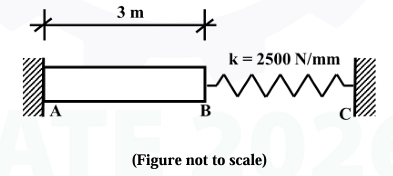
Rod AB has length L = 3000 mm, A = 500 mm², E = 60,000 MPa = 60,000 N/mm², α = 12×10⁻⁶/°C, ΔT = 100°C. Spring BC has stiffness k = 25 N/mm.
Free thermal expansion of rod AB:
δT = α × ΔT × L = 12×10⁻⁶ × 100 × 3000 = 3.6 mm
Axial stiffness of rod AB:
krod = AE/L = (500 × 60,000)/3000 = 10,000 N/mm
Compatibility condition:
Since both ends A and C are fixed, the free thermal expansion is completely resisted by the rod compression and spring compression. The same internal force P acts throughout:
δT = δrod + δspring
3.6 = P/krod + P/k
3.6 = P × (1/10,000 + 1/25)
3.6 = P × (10⁻⁴ + 0.04)
3.6 = P × 0.0401
P = 3.6/0.0401 = 89.8 ≈ 90.0 kN
The internal force developed in spring BC = 90.0 kN ✓

Total Unique Visitors