CS/IT Gate Yearwise
CS/IT Gate 2026 (Set 2)
CS/IT Gate 2025 (Set 1)
CS/IT Gate 2025 (Set 2)
CS/IT Gate 2024 (Set 1)
CS/IT Gate 2024 (Set 2)
CS/IT Gate 2023
CS/IT Gate 2022
CS/IT Gate 2021 (Set 1)
CS/IT Gate 2021 (Set 2)
CS/IT Gate 2020
CS/IT Gate 2019
CS/IT Gate 2018
CS/IT Gate 2017 (Set 1)
CS/IT Gate 2017 (Set 2)
CS/IT Gate 2016 (Set 1)
CS/IT Gate 2016 (Set 2)
CS/IT Gate 2015 (Set 1)
CS/IT Gate 2015 (Set 2)
CS/IT Gate 2015 (Set 3)
CS/IT Gate 2014 (Set 1)
CS/IT Gate 2014 (Set 2)
CS/IT Gate 2014 (Set 3)
CS and IT Gate 2026 Set-2 Questions with Answer
Ques 53 GATE 2026 SET-2
Suppose an unbiased coin is tossed 6 times. Each coin toss is independent of all previous coin tosses. Let E₁ be the event that among the second, fourth, and sixth coin tosses, there are at least two heads. Let E₂ be the event that among the first, second, third, and fifth coin tosses, there are equal number of heads and tails. The conditional probability P(E₁ | E₂) is equal to __________. (rounded off to one decimal place)
The correct answer is 0.5.
This is a conditional probability problem involving 6 independent fair coin tosses (T1 through T6). We need to find P(E₁ | E₂), where E₁ and E₂ are defined over overlapping but not identical subsets of tosses.
E₁ - among tosses 2, 4, 6, there are at least 2 heads. E₂ - among tosses 1, 2, 3, 5, there are equal heads and tails (exactly 2 heads, 2 tails).
Key Insight - Shared toss T2: Toss 2 is the only toss common to both events. Tosses T4 and T6 are entirely outside E₂'s scope, and tosses T1, T3, T5 are entirely outside E₁'s scope. Since all tosses are independent, T4 and T6 remain unconditionally fair (P = 1/2 each) even given E₂.
Conditional distribution of T2 given E₂: By symmetry of the 4 tosses in E₂, each individual toss is equally likely to be a head. So P(T2 = H | E₂) = 2/4 = 1/2 - the same as the unconditional probability.
Computing P(E₁ | E₂): Given E₂, the three tosses {T2, T4, T6} each independently show heads with probability 1/2. Therefore, the number of heads in {T2, T4, T6} given E₂ follows a Binomial(3, 1/2) distribution - identical to the unconditional case.
P(E₁ | E₂) = P(at least 2 heads in 3 fair tosses) = P(X=2) + P(X=3) = C(3,2)·(1/2)³ + C(3,3)·(1/2)³ = 3/8 + 1/8 = 4/8 = 0.5.
Ques 54 GATE 2026 SET-2
Consider a function 𝑓:(0,1)→{0,1} defined as follows.
For a real number 𝑟∈(0,1) , 𝑓(𝑟)=1 if the second digit after the decimal point
in 𝑟 is one of the four digits 2, 3, 6 and 7. Otherwise, 𝑓(𝑟) is equal to 0.
The number of points in (0,1) at which 𝑓 is discontinuous is ___________. (answer
in integer)
Propagation delay one-way = 3000 × 1000 m × 5 ns/m = 15 ms, so RTT = 30 ms.
Transmission time per byte = 8 bits ÷ 108 bps = 80 ns.
For max utilization, window size W ≥ 1 + 2a, where a = 15 ms ÷ 80 ns = 187,500 → W = 375,001 → needs ⌈log2(375,001)⌉ = 19 bits.
For no wrap-around in 60 seconds, bytes sent = 108 ÷ 8 × 60 = 750,000,000 → needs ⌈log2(750,000,000)⌉ = 30 bits.
N must satisfy both conditions, so N = max(19, 30) = 30.
The correct answer is N = 30.
Ques 55 GATE 2026 SET-2
It is necessary to design a link-layer protocol between two hosts that are directly
connected over a lossless link of length 3000 kilometers. Assume that the link
bandwidth is 108 bits per second and that the propagation delay in the link is 5
nanoseconds per meter. Every transmitted data byte is assigned a unique sequence
number.
Let 𝑁 be the minimum number of bits needed for the sequence number field in the
protocol header such that
i. the sequence numbers do not wrap around before 60 seconds, and
ii. the maximum utilization of the link is achieved.
The value of 𝑁 is ______. (answer in integer)
The correct answer is N = 30.
Given:
Wrap-around time = 60 seconds
Bandwidth = 108 bits per second = 108/8 bytes per second
Each transmitted data byte gets a unique sequence number.
Key insight: Since every byte has a unique sequence number, we need enough sequence numbers to cover all bytes transmitted during the wrap-around period of 60 seconds - so sequence numbers don''t repeat within that window.
Number of bytes transmitted in 60 seconds:
Bytes/sec = 108 / 8
Total bytes in 60s = 60 × (108 / 8) = 750,000,000 bytes
Minimum bits required:
2N ≥ 750,000,000
N ≥ log2(60 × 108/8) = log2(750,000,000) ≈ 29.48
N = ⌈29.48⌉ = 30
Note - the propagation delay is used to determine the window size for maximum utilization, but for the sequence number field size, the binding constraint is the wrap-around time condition. With 30 bits, we get 230 ≈ 1.07 billion unique sequence numbers - enough to cover all bytes in 60 seconds without any wrap-around.
Ques 56 GATE 2026 SET-2
Expedite, Hasten, Hurry, ________.
Fill the blank by choosing a word with a meaning similar to that of the words given above.
e correct answer is Option A - Accelerate.
All the given words - Expedite, Hasten, and Hurry - have a similar meaning. They all refer to making something happen faster or increasing the speed of an action.
Expedite means to make a process happen more quickly.
Hasten means to cause something to happen sooner.
Hurry means to act with speed.
Accelerate also means to increase the speed of something, so it matches the meaning of the given words.
Why other options are incorrect:
Option B - Retard: means to slow down or delay, which is the opposite meaning.
Option C - Provide: means to give or supply something, which is unrelated.
Option D - Disable: means to make something unable to function, which is completely different.
Ques 57 GATE 2026 SET-2
A day can only be cloudy or sunny. The probability of a day being cloudy is 0.5, independent of the condition on other days. What is the probability that in any given four days, there will be three cloudy days and one sunny day?
The correct answer is Option A — 1/4.
This is a classic Binomial probability problem. Each day independently has probability p = 0.5 of being cloudy and q = 0.5 of being sunny. We need exactly 3 cloudy days out of 4, which follows the binomial formula:
P(X = k) = C(n, k) × pk × q(n−k)
Here n = 4, k = 3, p = 0.5, q = 0.5:
P(X = 3) = C(4, 3) × (0.5)3 × (0.5)1 = 4 × (1/8) × (1/2) = 4/16 = 1/4.
C(4, 3) = 4 accounts for the 4 different ways to choose which 3 of the 4 days are cloudy (CCCS, CCSC, CSCC, SCCC). Each such arrangement has probability (0.5)3 × (0.5)1 = 1/16. Multiplying gives 4/16 = 1/4.
Why not Option D (3/8)? A common mistake is computing C(4,3) × (0.5)³ = 4/8 = 3/8, forgetting to multiply by (0.5)¹ for the one sunny day. Since the sunny day also has probability 0.5, it must be included in the product — giving (0.5)⁴ total, not (0.5)³.
Why not Option A being confused with 1/4 by intuition? One might guess 1/4 simply because 1 out of 4 days is sunny, but the actual derivation confirms the answer rigorously through the binomial formula.
Ques 58 GATE 2026 SET-2
The values of Stock A and Stock B on a particular day are Rs. 50 and Rs. 80, respectively. An investor invests Rs. 100 in Stock A and Rs. 80 in Stock B. He sells all the stocks the next day when the value of Stock A is Rs. 55 and Stock B is Rs. 70. The profit made by the investor is Rs. ______.
The correct answer is Option A — Rs. 0.
To find the total profit, we calculate the number of shares purchased, the selling value, and the net gain or loss for each stock separately, then combine them.
Stock A: The investor buys at Rs. 50 per share and invests Rs. 100, acquiring 100 ÷ 50 = 2 shares. The next day, Stock A is worth Rs. 55 per share, so the selling value is 2 × 55 = Rs. 110. Profit from Stock A = Rs. 110 − Rs. 100 = +Rs. 10.
Stock B: The investor buys at Rs. 80 per share and invests Rs. 80, acquiring 80 ÷ 80 = 1 share. The next day, Stock B falls to Rs. 70 per share, so the selling value is 1 × 70 = Rs. 70. Loss from Stock B = Rs. 70 − Rs. 80 = −Rs. 10.
Total profit = (+Rs. 10) + (−Rs. 10) = Rs. 0.
The gain on Stock A is exactly cancelled out by the loss on Stock B, leaving the investor with zero net profit. The total amount invested was Rs. 180 (100 + 80) and the total selling value is also Rs. 180 (110 + 70), confirming the answer.
Ques 59 GATE 2026 SET-2
When it is raining, peacocks dance.
Based only on this sentence, which one of the following options is necessarily true?
The correct answer is Option C — When peacocks are not dancing, it is not raining.
The given statement, "When it is raining, peacocks dance", is a conditional statement of the form R → D (Raining implies Dancing). In formal logic, only one transformation of a conditional is guaranteed to preserve its truth: the contrapositive.
The contrapositive of R → D is ¬D → ¬R — "If peacocks are not dancing, then it is not raining." This is logically equivalent to the original statement and is therefore necessarily true. This is Option C.
Option A — "Peacocks dance only when it is raining" (D → R): This is the converse of the original. The converse is not logically equivalent — peacocks could dance for reasons other than rain. Not necessarily true.
Option B — "When peacocks dance, it is raining" (D → R): Also the converse, same as Option A. Not necessarily true.
Option C — "When peacocks are not dancing, it is not raining" (¬D → ¬R): This is the contrapositive of the original, which is always logically equivalent to the original conditional. Necessarily true. Correct.
Option D — "When it is not raining, peacocks do not dance" (¬R → ¬D): This is the inverse of the original. Like the converse, the inverse is not logically equivalent — peacocks might still dance even when it is not raining. Not necessarily true.
The simple rule: of the four related conditionals (original, converse, inverse, contrapositive), only the contrapositive always shares the same truth value as the original.
Ques 60 GATE 2026 SET-2
Water : P :: Food : Q
Choose the P and Q combination from the options below to form a meaningful analogy.
The correct answer is Option A — P = Thirst; Q = Hunger.
This is a word analogy question asking us to identify the consistent relationship between Water and P, and between Food and Q. The analogy reads: Water is to P as Food is to Q.
The correct relationship is "substance : the biological craving or need for that substance." Thirst is the body''s need for water, and Hunger is the body''s need for food. Both pairs follow the exact same logical pattern, making the analogy complete and parallel.
Option A — P = Thirst, Q = Hunger: Water : Thirst and Food : Hunger — both are "substance : craving for that substance." The relationship is identical across both pairs. Correct.
Option B — P = Drink, Q = Hunger: "Drink" is an action performed with water, while "Hunger" is a craving. The relationship types are inconsistent across the two pairs — one is an action, the other a physiological state. Incorrect.
Option C — P = Thirst, Q = Satiated: "Thirst" is a craving that exists before consuming water, while "Satiated" is the state of fullness that exists after consuming food. The directions of the relationship are opposite, breaking the parallel. Incorrect.
Option D — P = Wet, Q = Critic: "Wet" is a property caused by water contact, and "Critic" has no meaningful relationship with food in this context. Both words are unrelated to each other in any consistent way. Incorrect.
The key to analogy questions is ensuring the same type of relationship holds for both pairs — here, "need/craving for" is the consistent link throughout.
Ques 61 GATE 2026 SET-2
A black square PQRS has been cut into two parts. One part of it is shown in Panel I. Which one of the shapes in Panel II is the other part?
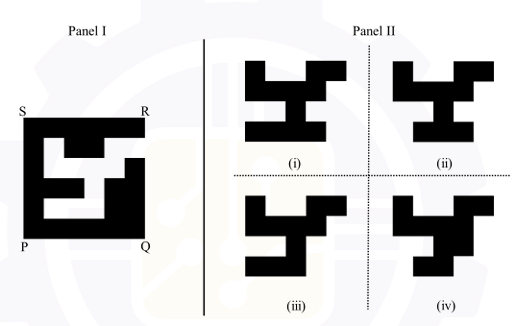
To find the correct missing part, we need to carefully examine the exact shape of the white negative space in Panel I, as this is the exact hole the missing black piece must perfectly fill.
Let''s break down the key features of this white space by tracing its "arms" extending from the central vertical trunk:
1. Top-Left: The white space forms an ''L'' shape pointing upwards and to the left.
2. Top-Right: The white space forms an ''L'' shape pointing upwards and to the right.
3. Bottom-Left: At the very bottom, there is a horizontal white arm extending to the left.
4. Middle-Right (The Key Feature): Look closely at the right side of the white space. Just below the top-right ''L'' shape, there is a small black block, and below that, a clear "peninsula" of white space extending to the right. This means our missing shape must have a prominent middle-right arm to fill this gap.
Now let''s evaluate the options in Panel II based on these features:
- Options (i) and (iii): If you look at the right side of their central trunks, they are perfectly straight. They completely lack the necessary middle-right arm to fill the gap in Panel I. ✗ Eliminate (i) and (iii).
- Options (ii) and (iv): Both of these shapes have the required middle-right arm. ✓ Keep (ii) and (iv).
To decide between the final two, look at the vertical position of that middle-right arm. In Panel I, the black block separating the top-right white arm from the middle-right white arm is relatively thin. This means these two right-pointing arms should be close together vertically.
- In Option (iv), the middle-right arm is positioned lower down the trunk, creating a large gap.
- In Option (ii), the middle-right arm is positioned higher up, closer to the top-right arm. This perfectly matches the precise proportions and spacing of the white negative space in Panel I.
Correct Answer: Option (ii)
Ques 62 GATE 2026 SET-2
Two tiles are missing in Panel I. Which one of the options in Panel II is the appropriate choice for the missing tiles?
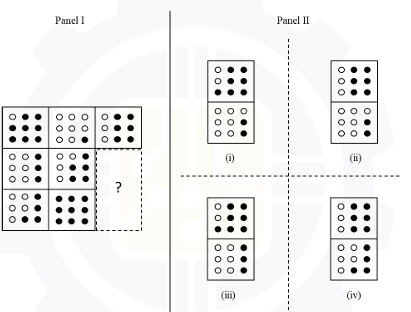
To solve this visual logic puzzle, we need to carefully count the number of white (hollow) dots inside each of the 3x3 tiles in Panel I.
Let''s map out the number of white dots for each known tile in the grid:
Row 1: 1, 8, 3
Row 2: 6, 4, ?
Row 3: 5, 0, ?
If we calculate the sum of the white dots in each complete row and column, a hidden pattern emerges:
- Sum of Row 1: 1 + 8 + 3 = 12
- Sum of Column 1: 1 + 6 + 5 = 12
- Sum of Column 2: 8 + 4 + 0 = 12
- Sum of Anti-Diagonal: 3 + 4 + 5 = 12
The entire grid forms a mathematical Magic Square where the number of white dots in every row, column, and diagonal must sum up to exactly 12.
Now, we can easily solve for the missing tiles in the third column:
- Top Missing Tile (Row 2, Col 3): 12 - (6 + 4) = 2 white dots.
- Bottom Missing Tile (Row 3, Col 3): 12 - (5 + 0) = 7 white dots.
Let''s evaluate the options in Panel II by counting their white dots:
- Option (i): The top tile has exactly 2 white dots. The bottom tile has exactly 7 white dots. (This matches our calculation perfectly!)
- Option (ii): The top tile has 3 white dots. The bottom tile has 7 white dots. ✗
- Option (iii): The top tile has 2 white dots. The bottom tile has 6 white dots. ✗
- Option (iv): The top tile has 3 white dots. The bottom tile has 6 white dots. ✗
Therefore, Option (i) is the correct choice to complete the puzzle.
Correct Answer: A (i) ✓
Ques 63 GATE 2026 SET-2
Figures (i) and (ii) represent intercity highway systems. The black dots represent cities and the line segments between them represent intercity highways. A salesperson needs to make a trip. She needs to start from a city, visit each of the remaining cities exactly once, and finally return to the same city from which she started.
Which one of the following options is then true?
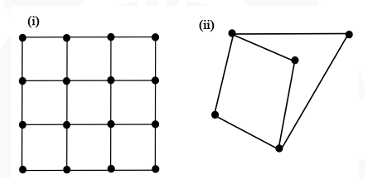
The correct answer is Option C — The salesperson can make the trip on both networks (i) and (ii).
The salesperson''s trip is a Hamiltonian Cycle problem — a closed path that visits every city (vertex) exactly once and returns to the starting city. We check if such a cycle exists in each network.
Figure (i) — 4×4 Grid Network (16 cities): For a grid graph G(m×n), a Hamiltonian cycle exists if and only if m×n is even and both m ≥ 2, n ≥ 2. Here 4×4 = 16 (even) and both dimensions exceed 1. The Hamiltonian cycle exists.
Figure (ii) — Irregular 5-city Network: All 5 vertices have degree ≥ 2, and by tracing the edges a valid Hamiltonian cycle can be found — visiting all 5 cities exactly once before returning to the start.
Since a Hamiltonian cycle exists in both networks, the salesperson can complete the required trip on both highway systems.
Key distinction: this is a Hamiltonian cycle (every city visited once), not an Eulerian circuit (every road traversed once). For grid graphs, the even-vertex rule directly determines Hamiltonicity.
Ques 64 GATE 2026 SET-2
The figure in Panel I below is a grid of cells with four rows and four columns. The numbers on the top and on the left represent the number of cells that are to be shaded in that column and row, respectively. Which one of the options shown in Panel II below represents the grid shaded correctly?
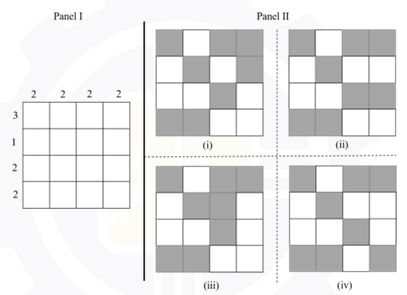
To find the correct grid, we must check each option to see if it satisfies the shading constraints given for the rows (left numbers) and columns (top numbers). Let''s evaluate the options row by row to eliminate the incorrect ones.
Checking Row 1 (Target: 3 shaded cells)
All four options (i, ii, iii, iv) have exactly 3 shaded cells in the first row. We cannot eliminate any options yet.
Checking Row 2 (Target: 1 shaded cell)
Option (i) has 2 shaded cells in this row. ✗ Eliminate (i).
Option (ii) has 1 shaded cell in this row. ✓ Keep (ii).
Option (iii) has 2 shaded cells in this row. ✗ Eliminate (iii).
Option (iv) has 1 shaded cell in this row. ✓ Keep (iv).
Checking Row 3 (Target: 2 shaded cells)
We only need to check our remaining options, (ii) and (iv).
Option (ii) has 2 shaded cells in this row. ✓ Keep (ii).
Option (iv) has only 1 shaded cell in this row. ✗ Eliminate (iv).
Verifying Option (ii)
Now let''s verify that Option (ii) satisfies all remaining constraints to be absolutely sure.
Rows: 3 (Matches), 1 (Matches), 2 (Matches), 2 (Row 4 has 2 shaded cells - Matches).
Columns:
Col 1 has 2 shaded cells. (Matches target 2)
Col 2 has 2 shaded cells. (Matches target 2)
Col 3 has 2 shaded cells. (Matches target 2)
Col 4 has 2 shaded cells. (Matches target 2)
Everything matches perfectly.
Correct Answer: Option (ii) ✓
Ques 65 GATE 2026 SET-2
An unbiased six-faced dice whose faces are marked with numbers 1, 2, 3, 4, 5, and 6 is rolled twice in succession and the number on the top face is recorded each time. The probability that the sum of the two recorded numbers is a prime number is ______.
A dice is rolled twice, so the total number of equally likely outcomes is 6 × 6 = 36. The sum of two dice can range from 2 to 12. Among these, the prime numbers are 2, 3, 5, 7, and 11. Note that 4, 6, 8, 9, 10 and 12 are not prime, and sums less than 2 or greater than 12 are not possible.
Now counting all ordered pairs (first roll, second roll) that give a prime sum:
Sum = 2 (prime): (1,1) → 1 way
Sum = 3 (prime): (1,2), (2,1) → 2 ways
Sum = 5 (prime): (1,4), (4,1), (2,3), (3,2) → 4 ways
Sum = 7 (prime): (1,6), (6,1), (2,5), (5,2), (3,4), (4,3) → 6 ways
Sum = 11 (prime): (5,6), (6,5) → 2 ways
Total favourable outcomes = 1 + 2 + 4 + 6 + 2 = 15
Probability = 15/36
Correct answer: C — 15/36 ✓

Total Unique Visitors