CS/IT Gate Yearwise
CS/IT Gate 2026 (Set 2)
CS/IT Gate 2025 (Set 1)
CS/IT Gate 2025 (Set 2)
CS/IT Gate 2024 (Set 1)
CS/IT Gate 2024 (Set 2)
CS/IT Gate 2023
CS/IT Gate 2022
CS/IT Gate 2021 (Set 1)
CS/IT Gate 2021 (Set 2)
CS/IT Gate 2020
CS/IT Gate 2019
CS/IT Gate 2018
CS/IT Gate 2017 (Set 1)
CS/IT Gate 2017 (Set 2)
CS/IT Gate 2016 (Set 1)
CS/IT Gate 2016 (Set 2)
CS/IT Gate 2015 (Set 1)
CS/IT Gate 2015 (Set 2)
CS/IT Gate 2015 (Set 3)
CS/IT Gate 2014 (Set 1)
CS/IT Gate 2014 (Set 2)
CS/IT Gate 2014 (Set 3)
CS and IT Gate 2015 Set-2 Questions with Answer
Ques 1 Gate 2015 Set-2
If p, q, r, s are distinct integers such that:
f(p, q, r, s) = max (p, q, r, s)
g(p, q, r, s) = min (p, q, r, s)
h(p, q, r, s) = remainder of (p × q) / (r × s) if (p × q) > (r × s) OR
remainder of (r × s) / (p × q) if (r × s) > (p × q)
Also a function fgh (p, q, r, s) =
f(p, q, r, s) × g(p, q, r, s) × h(p, q, r, s).
Also the same operation are valid with two variable functions
of the form f(p, q).
What is the value of fg(h(2, 5, 7, 3), 4, 6, 8)?
Given functions:
f(p, q, r, s) = max(p, q, r, s)
g(p, q, r, s) = min(p, q, r, s)
h(p, q, r, s) = remainder when larger product is divided by smaller product
We need to find: fg(h(2, 5, 7, 3), 4, 6, 8)
Let me start from the innermost function h(2, 5, 7, 3):
First, calculating the products:
p × q = 2 × 5 = 10
r × s = 7 × 3 = 21
Since (r × s) > (p × q), which means 21 > 10
h(2, 5, 7, 3) = remainder of 21 ÷ 10
h(2, 5, 7, 3) = 1
Now I need to find fg(1, 4, 6, 8):
Here fg means f × g (multiplication of f and g functions)
Calculating f(1, 4, 6, 8):
f(1, 4, 6, 8) = max(1, 4, 6, 8) = 8
Calculating g(1, 4, 6, 8):
g(1, 4, 6, 8) = min(1, 4, 6, 8) = 1
Therefore:
fg(1, 4, 6, 8) = f(1, 4, 6, 8) × g(1, 4, 6, 8)
fg(1, 4, 6, 8) = 8 × 1
fg(1, 4, 6, 8) = 8
Answer: fg(h(2, 5, 7, 3), 4, 6, 8) = 8
Ques 2 Gate 2015 Set-2
Out of the following four sentences, select the most suitable sentence with respect to grammar and usage
PROCESSED
Ques 3 Gate 2015 Set-2
If the list of letters, P, R, S, T, U is an arithmetic sequence, which of the following are also in arithmetic sequence?
I. 2P, 2R, 2S, 2T, 2U
II. P–3, R–3, S–3, T–3, U–3
III. P2, R2, S2, T2, U2
PROCESSED
Ques 4 Gate 2015 Set-2
Four branches of a company are located at M, N, O and P. M is north of N at a distance of 4 km; P is south of O at a distance of 2 km; N is southeast of O by 1 km. What is the distance between M and P in km?
PROCESSED
Ques 5 Gate 2015 Set-2
A generic term that includes various items of clothing such as a skirt, a pair of trousers and a shirt is
PROCESSED
Ques 6 Gate 2015 Set-2
Based on the given statements, select the most appropriate option to solve the given question. What will be the total weight of 10 poles each of same weight?
Statements:
(I) One fourth of the weight of a pole is 5 kg
(II) The total weight of these poles is 160 kg more
than the total weight of two poles.
PROCESSED
Ques 7 Gate 2015 Set-2
Choose the statement where underlined word is used correctly.
PROCESSED
Ques 8 Gate 2015 Set-2
We __________ our friend’s birthday and we ________ how to make it up to him.
PROCESSED
Ques 9 Gate 2015 Set-2
Consider the following C function.
{
int x=1, k;
if (n==1) return x;
for (k=1; k < n; ++k)
x = x + fun(k) * fun(n – k);
return x;
}
The return value of fun(5) is __________.
Ques 10 Gate 2015 Set-2
Consider the following function written in the C programming language.
{
if (*a && *a != ` `)
{
foo(a+1);
putchar(*a);
}
}
The output of the above function on input “ABCD EFGH” is
PROCESSED
Ques 11 Gate 2015 Set-2
In the context of abstract-syntax-tree (AST) and control-flow-graph (CFG), which one of the following is True?
PROCESSED
Ques 12 GATE 2015 SET-2
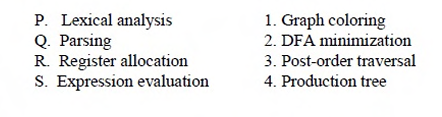
Match the following:
Ques 13 GATE 2015 SET-2
Consider the intermediate code given below.
(1) i = 1
(2) j = 1
(3) t1 = 5 * i
(4) t2 = t1 + j
(5) t3 = 4 * t2
(6) t4 = t3
(7) a[t4] = -1
(8) j = j + 1
(9) if j ≤ 5 goto (3)
(10) i = i + 1
(11) if i < 5 goto (2)
The number of nodes and edges in the control-flow-graph constructed for the above code, respectively, are

Total Unique Visitors