CS/IT Gate Yearwise
CS/IT Gate 2026 (Set 2)
CS/IT Gate 2025 (Set 1)
CS/IT Gate 2025 (Set 2)
CS/IT Gate 2024 (Set 1)
CS/IT Gate 2024 (Set 2)
CS/IT Gate 2023
CS/IT Gate 2022
CS/IT Gate 2021 (Set 1)
CS/IT Gate 2021 (Set 2)
CS/IT Gate 2020
CS/IT Gate 2019
CS/IT Gate 2018
CS/IT Gate 2017 (Set 1)
CS/IT Gate 2017 (Set 2)
CS/IT Gate 2016 (Set 1)
CS/IT Gate 2016 (Set 2)
CS/IT Gate 2015 (Set 1)
CS/IT Gate 2015 (Set 2)
CS/IT Gate 2015 (Set 3)
CS/IT Gate 2014 (Set 1)
CS/IT Gate 2014 (Set 2)
CS/IT Gate 2014 (Set 3)
CS and IT Gate 2026 Set-1 Questions with Answer
Ques 40 GATE 2026 SET-1
For n > 1, the maximum multiplicity of any eigenvalue of an n × n matrix with elements from ℜ is:
The characteristic polynomial of an n × n matrix is a degree-n polynomial.
det(A − λI) = 0
A degree-n polynomial has exactly n roots (counting multiplicity) over the complex numbers. Therefore, the sum of multiplicities of all eigenvalues can be at most n.
The maximum multiplicity of a single eigenvalue occurs when all n roots of the characteristic polynomial are the same value.
Example: The identity matrix I of size n × n has the characteristic polynomial:
det(I − λI) = (1 − λ)n = 0
This gives λ = 1 with multiplicity n.
Eliminating wrong options:
n + 1 - impossible since the characteristic polynomial is only degree n, it cannot have n+1 roots.
1 - too restrictive, eigenvalues can repeat.
n − 1 - incorrect, as shown by the identity matrix example where multiplicity reaches n.
The maximum multiplicity of any eigenvalue of an n × n real matrix is n (Option C)
Ques 41 GATE 2026 SET-1
Consider 4 × 4 matrices with their elements from {𝟎, 𝟏}. The number of such matrices with even number of 𝟏s in every row and every column is
The correct answer is Option C: 512.
The key idea is to figure out how many entries can be chosen freely, with the rest being determined by the parity constraints.
Consider filling the top-left 3×3 submatrix (the first 3 rows and first 3 columns) with any combination of 0s and 1s. There are 29 = 512 ways to do this.
Once these 9 entries are fixed:
• The 4th entry in each of the first 3 rows is forced - it must make the row sum even.
• The entire 4th row is forced - each entry must make its column sum even.
• The bottom-right entry (row 4, column 4) is automatically consistent with both the row and column parity constraints, because the total sum of the matrix (mod 2) must be 0, which follows from all row sums being even.
So every free choice of the 3×3 submatrix gives exactly one valid 4×4 matrix, and every valid matrix corresponds to exactly one such choice.
Total = 29 = 512.
Ques 42 GATE 2026 SET-1
An unbiased six-faced dice whose faces are marked with numbers 1, 2, 3, 4, 5, and 6 is rolled twice in succession and the number on the top face is recorded each time. The probability that the number appearing in the second roll is an integer multiple of the number appearing in the first roll is __________
The correct answer is Option C: 7/18.
Total possible outcomes when a die is rolled twice = 6 × 6 = 36.
We need to count pairs (a, b) where b is an integer multiple of a:
• First roll = 1: multiples in {1,2,3,4,5,6} → {1,2,3,4,5,6} → 6 pairs
• First roll = 2: multiples → {2,4,6} → 3 pairs
• First roll = 3: multiples → {3,6} → 2 pairs
• First roll = 4: multiples → {4} → 1 pair
• First roll = 5: multiples → {5} → 1 pair
• First roll = 6: multiples → {6} → 1 pair
Total favorable outcomes = 6 + 3 + 2 + 1 + 1 + 1 = 14
P = 14/36 = 7/18
Ques 43 GATE 2026 SET-1
An urn contains one red ball and one blue ball. At each step, a ball is picked uniformly at random from the urn, and this ball together with another ball of the same color is put back in the urn. The probability that there are equal number of red and blue balls after two steps is
Start with 1 Red and 1 Blue ball. At each step, pick one ball at random, then return it along with a new ball of the same colour. After two steps the urn has 4 balls. We want the probability of having exactly 2 Red and 2 Blue.
After Step 1:
Picking Red (probability 1/2) gives urn state (2R, 1B).
Picking Blue (probability 1/2) gives urn state (1R, 2B).
After Step 2 from state (2R, 1B):
Picking Red (probability 2/3) gives (3R, 1B) — unequal.
Picking Blue (probability 1/3) gives (2R, 2B) — equal ✓
After Step 2 from state (1R, 2B):
Picking Red (probability 1/3) gives (2R, 2B) — equal ✓
Picking Blue (probability 2/3) gives (1R, 3B) — unequal.
Total probability:
P(equal) = P(2R,1B) × P(equal | 2R,1B) + P(1R,2B) × P(equal | 1R,2B)
= (1/2 × 1/3) + (1/2 × 1/3)
= 1/6 + 1/6 = 1/3
Correct answer: B — 1/3 ✓
Ques 44 GATE 2026 SET-1
Let n > 1. Consider an n × n matrix M with its elements from ℝ. Let the vector (0, 1, 0, 0, …, 0) ∈ ℝn be in the null space of M.
Which of the following options is/are always correct?
The vector e₂ = (0,1,0,...,0) being in the null space means Me₂ = 0. Multiplying any matrix M by the standard basis vector e₂ simply extracts the second column of M. So Me₂ = 0 tells us directly that the second column of M is all zeros.
Option A — False
If the second column is all zeros, then det(M) = 0, not 1. A determinant of 1 would require M to be non-singular, but a zero column makes it singular. A is false.
Option B — True
The determinant of any matrix with a zero column is always 0. This follows from the multilinearity of the determinant — scaling any column by 0 scales the determinant by 0. Since the second column is identically zero, det(M) = 0 always. B is always true.
Option C — False
Rank cannot be pinned to exactly 1. A matrix with a zero second column could have rank anywhere from 0 (all columns zero) to n−1 (only the second column zero, all others linearly independent). The rank is not determined solely by having one zero column. C is not always true.
Option D — True
The null space of M is a subspace of ℝn. Since it contains the non-zero vector e₂, it must contain all scalar multiples of e₂ — including 2e₂, 3e₂, −e₂ and infinitely more. In particular it always contains at least two non-zero vectors. D is always true.
Correct answer: B and D ✓
Ques 45 GATE 2026 SET-1
Consider the function f: ℝ → ℝ defined as follows:
f(x) = c1ex − c2 loge(1/x), if x > 0
f(x) = 3, otherwise
where c1, c2 ∈ ℝ.
If f is continuous at x = 0, then c1 + c2 = _________. (answer in integer)
For f to be continuous at x = 0, the right-hand limit as x → 0+ must equal f(0) = 3.
First simplify the expression for x > 0. Since loge(1/x) = −loge(x), the function becomes f(x) = c1ex + c2loge(x) for x > 0.
Taking the limit as x → 0+:
— c1ex → c1e0 = c1 (finite for any c1)
— c2loge(x) → c2 × (−∞) as x → 0+
For the limit to be finite and equal to 3, the logarithm term must not blow up. The only way to prevent this is to have c2 = 0.
With c2 = 0, the limit becomes simply c1. For continuity this must equal f(0) = 3, so c1 = 3.
Therefore c1 + c2 = 3 + 0 = 3.
Correct answer: 3 ✓
Ques 46 GATE 2026 SET-1
Let f: ℝ → ℝ be defined as follows:
f(x) = (|x|/2 − x)(x − |x|/2)
Which of the following statements is/are true?
First simplify f(x) by splitting into cases based on the sign of x.
For x ≥ 0: |x| = x, so f(x) = (x/2 − x)(x − x/2) = (−x/2)(x/2) = −x2/4
For x ≤ 0: |x| = −x, so f(x) = (−x/2 − x)(x + x/2) = (−3x/2)(3x/2) = −9x2/4
Both pieces give f(0) = 0, confirming continuity at the origin.
Option A — True: f has a local maximum
For all x ≠ 0, f(x) is negative (both −x2/4 and −9x2/4 are negative for x ≠ 0), while f(0) = 0. So f(0) = 0 is strictly greater than f(x) for all nearby x ≠ 0. Therefore x = 0 is a local maximum.
Option B — False: f has no local minimum
For x > 0, f(x) = −x2/4 is strictly decreasing toward −∞. For x < 0, f(x) = −9x2/4 also decreases toward −∞ as x moves away from 0. Neither branch has a turning point below zero. There is no local minimum anywhere.
Option C — True: f′ is continuous over ℝ
For x > 0: f′(x) = −x/2. For x < 0: f′(x) = −9x/2. At x = 0, the left-hand derivative = limx→0⁻(−9x/2) = 0 and the right-hand derivative = limx→0⁺(−x/2) = 0. Both equal zero, so f′(0) = 0 and f′ is continuous everywhere.
Option D — True: f′ is not differentiable over ℝ
f′(x) = −9x/2 for x < 0 and f′(x) = −x/2 for x > 0. The derivative of f′ from the left at 0 is −9/2 and from the right is −1/2. Since these differ, f′ is not differentiable at x = 0.
Correct answer: A, C, D ✓
Ques 47 GATE 2026 SET-1
Consider a knock-out women's badminton single tournament where there are no ties. The loser in each game is eliminated from the tournament. Every player plays until she is defeated or remains the last undefeated player. The last undefeated player is declared the winner of the tournament. If there are 64 players in the beginning of the tournament, how many games should be played in total to declare the winner of the tournament?
Explanation:
1. Total Number of Players: There are 64 players participating in the tournament.
2. Tournament Rule: It is a single-elimination (knock-out) tournament, meaning a player is immediately eliminated after losing a single game.
3. Determining the Winner: To find a single winner, all other players must be eliminated. Therefore, the number of players to be eliminated is: 64 - 1 = 63 players.
4. Game-to-Elimination Ratio: Since each game results in exactly one loser and no ties are possible, 1 game = 1 elimination.
5. Conclusion: To eliminate 63 players, exactly 63 games must be played in total.
Alternative Round-by-Round Breakdown:
• Round 1: 64 players pair up into 32 games (32 winners, 32 eliminated)
• Round 2: 32 players pair up into 16 games (16 winners, 16 eliminated)
• Round 3: 16 players pair up into 8 games (8 winners, 8 eliminated)
• Round 4: 8 players pair up into 4 games (4 winners, 4 eliminated)
• Round 5: 4 players pair up into 2 games (2 winners, 2 eliminated)
• Round 6 (Finals): 2 players play 1 game (1 winner, 1 eliminated)
• Total games = 32 + 16 + 8 + 4 + 2 + 1 = 63 games.
Ques 48 GATE 2026 SET-1
A student needs to enroll for a minimum of 60 credits. A student cannot enroll for more than 70 credits. Credits are divided among projects and three distinct sets of courses namely, Core, Specialization and Elective. It is compulsory for a student to enroll for exactly 15 credits of Core and exactly 20 credits for project. In addition, a student has to enroll for a minimum of 10 credits of Specialization. The maximum credits of Elective course that a student can enroll for is ______.
Explanation:
1. Total Credits Formula: Total Credits = Core + Project + Specialization + Elective
2. Given Fixed Values: Core = 15 credits, Project = 20 credits.
• This gives a fixed total of: 15 + 20 = 35 credits.
• The equation becomes: Total Credits = 35 + Specialization + Elective
3. Constraints:
• Maximum Total Credits = 70
• Minimum Specialization Credits = 10
4. Maximizing Elective Credits: To make Elective credits as high as possible, we must maximize the Total Credits (70) and minimize the Specialization credits (10).
5. Calculation:
• 70 = 35 + 10 + Elective
• 70 = 45 + Elective
• Elective = 70 - 45 = 25 credits.
Ques 49 GATE 2026 SET-1
The antonym of the word protagonist is ______.
A protagonist is the leading character or main figure in a story, debate, or cause — the one who drives events forward and whose goals the narrative follows. The word comes from Greek "protos" (first) and "agonist" (actor or combatant).
Its direct antonym is antagonist — the character or force that opposes the protagonist, creating conflict. Antagonist comes from the same Greek root "agonist" but with the prefix "anti" (against), literally meaning one who fights against the main actor.
The other options are distractors that rhyme or sound similar but have completely different meanings — agnostic refers to one who is uncertain about the existence of God, arsonist is someone who deliberately sets fires, and anarchist is someone who rejects organised authority and hierarchy. None of these carry the meaning of "opponent of the main character."
Correct answer: B — Antagonist ✓
Ques 50 GATE 2026 SET-1
'When the teacher is in the room, all students stand silently.' If the above statement is true, which one of the following statements is not necessarily true?
The original statement is: "When the teacher is in the room, all students stand silently." In logic this is T → S where T = teacher in room and S = all students stand silently.
Option A — Always true
This is the contrapositive — if any student is NOT standing silently then the teacher cannot be in the room. The contrapositive is logically equivalent to the original statement and is always true.
Option B — Always true
The original says students "stand silently" — silence is part of this. So when the teacher is present, students are certainly silent (along with standing). This is a weaker claim than the original and must be true.
Option C — Not necessarily true
This is the converse of the original — concluding the teacher is present whenever all students are standing. The converse of a true statement is not necessarily true. Students might all stand for other reasons — a school assembly, another authority figure entering, or simply out of habit — without the teacher being present. The original gives no information about what happens when students stand independently. C is not necessarily true.
Option D — Always true
Standing is a component of "standing silently." If all students stand silently when the teacher enters, then they are certainly standing. This is always true.
Correct answer: C ✓
Ques 51 GATE 2026 SET-1
Combinatorics deals with problems involving counting. For example, "How many distinct arrangements of N distinct objects in M spaces on a circle are possible?" is a typical problem in combinatorics. This kind of counting is sometimes used in the modeling of several physical phenomena. Often, in such models, the different combinatorial possibilities are assigned probability values. Assigning probabilities enables the computation of the average values of physical quantities.
Consider the following statements:
P: Combinatorics is always invoked in the modeling of physical phenomena.
Q: Modeling some physical phenomena involves assigning probabilities to combinatorial possibilities in order to compute average values of physical quantities.
Based on the passage above, what can be inferred about statements P and Q?
This is a reading comprehension and inference question based strictly on what the passage states.
Statement P — False
P claims combinatorics is "always" used in modeling physical phenomena. The passage uses the word "sometimes" — "This kind of counting is sometimes used in the modeling of several physical phenomena." The word sometimes explicitly means not always. Since the passage only supports a partial/occasional use, the absolute claim in P is not supported. P is false.
Statement Q — True
Q claims that modeling some physical phenomena involves assigning probabilities to combinatorial possibilities to compute average values. The passage states "Often, in such models, the different combinatorial possibilities are assigned probability values. Assigning probabilities enables the computation of the average values of physical quantities." This directly and fully supports Q. Q is true.
Correct answer: B — P is False and Q is True ✓
Ques 52 GATE 2026 SET-1
For positive real numbers S and K, the function HK(S) is defined as:
HK(S) = max(S − K, 0). The max function is defined as:
max(a, b) = a when a > b; b when a ≤ b.
The graph below shows the plot of a function N(S) versus S. N(S) can be expressed as ______.
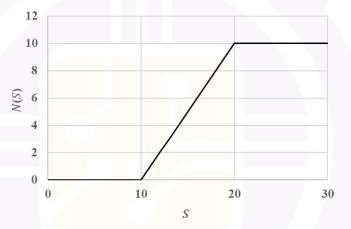
From the graph, N(S) has three distinct regions:
N(S) = 0 for S ≤ 10, rises linearly from 0 to 10 for 10 < S ≤ 20, and stays flat at 10 for S > 20.
The key insight is to recognise this as a bull spread payoff — starting from zero, rising with slope 1, then capping out. This is exactly what you get when you subtract two call option payoffs with different strike prices.
Evaluating H10(S) − H20(S) across all three regions:
For S ≤ 10: H10(S) = 0 and H20(S) = 0, so N(S) = 0 − 0 = 0. Matches the flat zero section ✓
For 10 < S ≤ 20: H10(S) = S − 10 and H20(S) = 0, so N(S) = (S − 10) − 0 = S − 10. At S=10 this gives 0 and at S=20 this gives 10 — matches the rising section with slope 1 ✓
For S > 20: H10(S) = S − 10 and H20(S) = S − 20, so N(S) = (S−10) − (S−20) = 10. Matches the flat cap at 10 ✓
Options B, C, and D all fail to match the graph in at least one region — B gives a decreasing value beyond S=20, C gives negative values between S=10 and S=20, and D starts rising only at S=15 instead of S=10.
Correct answer: A — H10(S) − H20(S) ✓

Total Unique Visitors