CS/IT Gate Yearwise
CS/IT Gate 2026 (Set 2)
CS/IT Gate 2025 (Set 1)
CS/IT Gate 2025 (Set 2)
CS/IT Gate 2024 (Set 1)
CS/IT Gate 2024 (Set 2)
CS/IT Gate 2023
CS/IT Gate 2022
CS/IT Gate 2021 (Set 1)
CS/IT Gate 2021 (Set 2)
CS/IT Gate 2020
CS/IT Gate 2019
CS/IT Gate 2018
CS/IT Gate 2017 (Set 1)
CS/IT Gate 2017 (Set 2)
CS/IT Gate 2016 (Set 1)
CS/IT Gate 2016 (Set 2)
CS/IT Gate 2015 (Set 1)
CS/IT Gate 2015 (Set 2)
CS/IT Gate 2015 (Set 3)
CS/IT Gate 2014 (Set 1)
CS/IT Gate 2014 (Set 2)
CS/IT Gate 2014 (Set 3)
CS and IT Gate 2025 Set-1 Questions with Answer
Ques 14 GATE 2025 SET-1
Suppose a message of size 15000 bytes is transmitted from a source to a destination using IPv4 protocol via two routers as shown in the figure. Each router has a defined maximum transmission unit (MTU) as shown in the figure, including IP header. The number of fragments that will be delivered to the destination is ______ (Answer in integer)
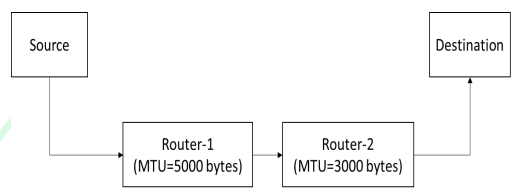
IP header = 20 bytes. Original message = 15000 bytes total, so data payload = 14980 bytes.
At Router-1 (MTU = 5000 bytes):
Max data per fragment = 5000 - 20 = 4980 bytes. Rounded down to nearest multiple of 8 = 4976 bytes.
Fragments created: 4976 + 4976 + 4976 + 52 = 14980 bytes → 4 fragments
At Router-2 (MTU = 3000 bytes):
Max data per fragment = 3000 - 20 = 2980. Rounded down to multiple of 8 = 2976 bytes.
Each of the three 4976-byte fragments is split into 2 (2976 + 2000), and the 52-byte fragment passes through unchanged.
Total = 3 × 2 + 1 = 7 fragments delivered to the destination.
Ques 15 GATE 2025 SET-1
Suppose a program is running on a non-pipelined single processor computer system. The computer is connected to an external device that can interrupt the processor asynchronously. The processor needs to execute the interrupt service routine (ISR) to serve this interrupt. The following steps (not necessarily in order) are taken by the processor when the interrupt arrives:
(i) The processor saves the content of the program counter.
(ii) The program counter is loaded with the start address of the ISR.
(iii) The processor finishes the present instruction.
Which ONE of the following is the CORRECT sequence of steps?
Explanation:
1. Step 1 — Finish Present Instruction (iii): An asynchronous interrupt can arrive at any arbitrary point during an instruction cycle. To ensure system stability and prevent corruption of program state, the processor will always complete the execution of the currently running instruction before responding to or servicing the interrupt.
2. Step 2 — Save Program Counter (i): Once the current instruction finishes, the processor prepares to context-switch to the ISR. Before jumping away, it must save the current content of the Program Counter (PC)—which points to the next instruction of the interrupted program—onto the stack. This allows the processor to seamlessly resume the original program later.
3. Step 3 — Load ISR Address (ii): After safely storing the return address, the Program Counter is updated and loaded with the starting address of the Interrupt Service Routine (ISR) so that the processor can begin executing the interrupt code on the next clock cycle.
4. Conclusion: Therefore, the exact order of execution is (iii) → (i) → (ii).
Ques 16 GATE 2025 SET-1
The number -6 can be represented as 1010 in 4-bit 2's complement representation. Which of the following is/are CORRECT 2's complement representation(s) of -6?
Correct Answer:
b and d (Multiple Select Question)
Explanation:
1. Concept of Sign Extension: In 2's complement representation, when you want to extend a signed integer from a smaller number of bits to a larger number of bits (e.g., from 4 bits to 8 bits or 16 bits), you perform an operation called sign extension.
• To do this, you simply look at the most significant bit (MSB), which is the leftmost sign bit.
• You replicate (copy) that sign bit into all the new higher-order positions to fill the extra space.
2. Analyze the Original Value:
• The original 4-bit representation of -6 is 1010.
• The sign bit (MSB) is 1 (indicating a negative value).
3. Convert to 8-bits:
• We need to add 4 extra bits to the left.
• Since the sign bit is 1, we extend it by adding four 1s: 1111.
• Combining them gives: 1111 1010.
• Therefore, Statement (b) is Correct and Statement (a) is Incorrect.
4. Convert to 16-bits:
• We need to add 12 extra bits to the left of the original 4 bits.
• Since the sign bit is 1, we copy it 12 times: 1111 1111 1111.
• Combining them gives: 1111 1111 1111 1010.
• Therefore, Statement (d) is Correct and Statement (c) is Incorrect.
Ques 17 GATE 2025 SET-1
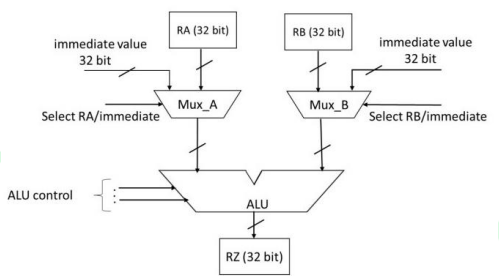
A partial data path of a processor is given in the figure, where RA, RB, and RZ are 32-bit registers. Which option(s) is/are CORRECT related to arithmetic operations using the data path as shown?
Explanation:
1. Analyze the Input Multiplexers (Mux_A and Mux_B):
The diagram shows that the inputs to the ALU are fully controlled by two independent multiplexers, Mux_A and Mux_B:
• Mux_A Inputs: Can choose between register RA (32 bit) OR an immediate value 32 bit.
• Mux_B Inputs: Can choose between register RB (32 bit) OR an immediate value 32 bit.
2. Evaluate the Combinations:
Because the select lines (Select RA/immediate and Select RB/immediate) work independently of each other, we can configure them to route different combinations of variables straight to the ALU:
• Combination 1 (Two Registers): Set Mux_A to select RA and Mux_B to select RB. This allows arithmetic operations involving two registers. (Statement a is True)
• Combination 2 (One Register, One Immediate): Set Mux_A to select RA and Mux_B to select its immediate value (or vice versa). This allows arithmetic operations involving one register and one immediate value. (Statement b is True)
• Combination 3 (Two Immediate Values): Set both Mux_A and Mux_B to select their respective immediate values. This allows arithmetic operations involving two immediate values simultaneously. (Statement c is True)
3. Evaluate Statement (d):
• Statement (d) claims that the data path can only implement operations between one register and one immediate value. Since we proved it can handle two registers or two immediate values as well, this statement is False.
4. Conclusion:
Statements (a), (b), and (c) are all completely valid configurations supported by the provided multiplexer layout.
Ques 18 GATE 2025 SET-1
Consider a memory system with 1M bytes of main memory and 16K bytes of cache memory. Assume that the processor generates 20-bit memory address, and the cache block size is 16 bytes. If the cache uses direct mapping, how many bits will be required to store all the tag values? [Assume memory is byte addressable, 1K=210, 1M=220.]
Explanation:
To find the total number of bits required to store all tag values in a direct-mapped cache, we first need to break down the structure of the physical address and determine how many tags (lines) the cache contains.
1. Analyze the Physical Address Structure:
The processor generates a 20-bit memory address. In a direct-mapped cache, this address is split into three fields:
• Block Offset Bits:
The cache block size is 16 bytes = 24 bytes.
Since the memory is byte-addressable, the number of bits needed for the block offset = 4 bits.
• Index (Line) Bits:
To find the number of lines (slots) in the cache:
Number of Cache Lines = Cache Size / Block Size
Number of Cache Lines = 16K bytes / 16 bytes = 1K lines = 210 lines.
Therefore, the number of bits needed to index these lines = 10 bits.
• Tag Bits:
Tag Bits = Total Address Bits - (Index Bits + Block Offset Bits)
Tag Bits = 20 - (10 + 4) = 20 - 14 = 6 bits per cache line.
2. Calculate Total Bits Required for All Tags:
Each of the cache lines requires its own tag store.
Total Tag Bits = Number of Cache Lines × Tag Bits per Line
Total Tag Bits = 210 × 6 bits = 6 × 210 bits.
3. Conclusion:
The total storage capacity needed to hold all tag structures is exactly 6×210 bits, which perfectly matches option (a).
Ques 19 GATE 2025 SET-1
A processor has 64 general-purpose registers and 50 distinct instruction types. An instruction is encoded in 32-bits. What is the maximum number of bits that can be used to store the immediate operand for the given instruction?
ADD R1, #25 //R1=R1+25
Explanation:
To find the maximum number of bits available for an immediate operand, we need to calculate how many bits of the 32-bit instruction must be allocated to the Opcode (instruction type) and the register fields.
1. Calculate Opcode Bits:
The processor supports 50 distinct instruction types. To uniquely represent 50 operations, the number of bits required for the opcode field is:
25 < 50 ≤ 26 → 6 bits are required.
2. Calculate Register Bits:
The processor has 64 general-purpose registers. To address any one of the 64 unique registers, the number of bits required per register field is:
26 = 64 → 6 bits are required per register.
3. Analyze the Target Instruction Type:
Look at the example given: ADD R1, #25 (which represents $R1 = R1 + 25$).
• This is an instruction that involves one destination register ($R1$), one source register (also $R1$ since it reads and modifies it), and one immediate operand ($25$).
• Therefore, the instruction structure must allocate bits for: [ Opcode ] [ Register Destination ] [ Immediate Value ].
4. Calculate the Remaining Bits for the Immediate Operand:
Subtract the bits consumed by the opcode and the single referenced register field from the total instruction size:
Bits for Immediate Operand = Total Bits - Opcode Bits - Register Bits
Bits for Immediate Operand = 32 - 6 - 6 = 20 bits.
5. Conclusion:
The maximum size of the immediate field for this instruction type is exactly 20 bits, matching option (b).
Ques 20 GATE 2025 SET-1
A computer has a memory hierarchy consisting of two-level cache (L1 and L2) and a main memory. If the processor needs to access data from memory, it first looks into L1 cache. If the data is not found in L1 cache, it goes to L2 cache. If it fails to get the data from L2 cache, it goes to main memory, where the data is definitely available. Hit rates and access times of various memory units are shown in the figure. The average memory access time in nanoseconds (ns) is ______ (rounded off to two decimal places)
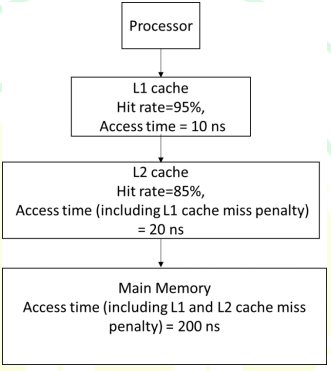
AMAT = TL1 + (1 - HL1) × [TL2 + (1 - HL2) × TMM]
where TL1, TL2, TMM are the access times of L1, L2, and main memory, and HL1, HL2 are their respective hit rates.
Every memory access always checks L1 first (TL1 is always paid). On an L1 miss, L2 is checked. On an L2 miss, main memory is accessed.
Substituting the values from the given figure into the formula gives an AMAT of approximately 11.85 ns, which falls within the official accepted range of 11.83 to 11.87.
Ques 21 GATE 2025 SET-1
Which of the following statement(s) is/are TRUE for any binary search tree (BST) having n distinct integers?
Statement A: The maximum length of a path from the root node to any other node is (n-1).
Analysis: In a skewed BST (all nodes in a single line), the path from root to the deepest node has (n-1) edges.
Example: BST with nodes 1→2→3→4→5 has maximum path length = 4 = (5-1)
Result: TRUE ✓
Statement B: An inorder traversal will always produce a sorted sequence of elements.
Analysis: By definition of BST, left subtree < root < right subtree. Inorder traversal (Left→Root→Right) always visits nodes in ascending order.
Example: BST with root 5, left child 3, right child 7 gives inorder: 3, 5, 7 (sorted)
Result: TRUE ✓
Statement C: Finding an element takes O(log₂n) time in the worst case.
Analysis: In the worst case, BST becomes skewed (like a linked list) and finding an element takes O(n) time, not O(log₂n).
O(log₂n) is only for balanced BST, not for any BST.
Result: FALSE ✗
Statement D: Every BST is also a Min-Heap.
Analysis: Min-Heap property: parent < both children (for all nodes).
BST property: left child < parent < right child.
In BST, the right child can be greater than parent, violating Min-Heap property.
Example: BST with root 5, left child 3, right child 7. Here 7 > 5, so not a Min-Heap.
Result: FALSE ✗
Answer: A and B are TRUE
Ques 22 GATE 2025 SET-1
The height of any rooted tree is defined as the maximum number of edges in the path from the root node to any leaf node.
Suppose a Min-Heap T stores 32 keys. The height of T is ______ (Answer in integer)
Given: Min-Heap with 32 keys
Min-Heap structure:
A Min-Heap is a complete binary tree where every node is smaller than its children.
Formula for height of complete binary tree
For a complete binary tree with n nodes:
Height (h) = ⌊log₂(n)⌋
where ⌊ ⌋ means floor function (round down)
Calculating the height
Number of nodes (n) = 32
Height = ⌊log₂(32)⌋
Height = ⌊log₂(2⁵)⌋
Height = ⌊5⌋
Height = 5
Verification:
A complete binary tree of height 5 has:
- Minimum nodes = 2⁵ = 32 nodes
- Maximum nodes = 2⁶ - 1 = 63 nodes
Since we have exactly 32 nodes, height = 5
Answer: 5
Ques 23 GATE 2025 SET-1
In a double hashing scheme, h1(k)=k mod 11 and h2(k)=1+(k mod 7) are the auxiliary hash functions. The size m of the hash table is 11. The hash function for the i-th probe in the open address table is [h1(k)+i h2(k)] mod m. The following keys are inserted in the given order: 63, 50, 25, 79, 67, 24.
The slot at which key 24 gets stored is ______ (Answer in integer)
The correct answer is Slot 10.
Given: h1(k) = k mod 11, h2(k) = 1 + (k mod 7), table size m = 11.
Probe formula: (h1(k) + i × h2(k)) mod 11
First, insert all preceding keys to know which slots are occupied:
63: 63 mod 11 = 8 → Slot 8
50: 50 mod 11 = 6 → Slot 6
25: 25 mod 11 = 3 → Slot 3
79: 79 mod 11 = 2 → Slot 2
67: 67 mod 11 = 1 → Slot 1
Occupied slots before inserting 24: {1, 2, 3, 6, 8}
Now insert key 24:
h1(24) = 24 mod 11 = 2 → Slot 2 occupied (79)
h2(24) = 1 + (24 mod 7) = 1 + 3 = 4
Probe i=1: (2 + 1×4) mod 11 = 6 → occupied (50)
Probe i=2: (2 + 2×4) mod 11 = 10 mod 11 = 10 → empty ✓
Key 24 is stored at Slot 10.
Ques 24 GATE 2025 SET-1
A schedule of three database transactions T1, T2, and T3 is shown.
Ri(A) and Wi(A) denote read and write of data item A by transaction Ti,i=1,2,3.
The transaction T1 aborts at the end. Which other transaction(s) will be required to be rolled back?
R1(X)W1(Y)R2(X)R2(Y)R3(Y)ABORT(T1)
Explanation:
1. Analyze the Sequence of Operations:
Let's look closely at the chronological execution order of the schedule:
• T1 performs a write operation on data item Y: W1(Y)
• T2 subsequently performs a read operation on the same data item Y: R2(Y)
• T3 then performs a read operation on the same data item Y: R3(Y)
• T1 fails and encounters an abort operation: ABORT(T1)
2. Identify Dirty Reads (Data Dependency):
• Because T2 reads the value of Y after T1 wrote it but before T1 committed or aborted, T2 has performed a dirty read from T1.
• Similarly, because T3 reads the value of Y after T1 wrote it, T3 has also performed a dirty read from T1.
3. Cascading Rollback Mechanism:
• When a transaction aborts, any changes it made to the database are completely undone.
• Since T2 and T3 read an uncommitted, temporary value of Y produced by T1, their computations are based on dirty, invalid data.
• To maintain database consistency and isolation, any transaction that has read uncommitted data from an aborted transaction must also be rolled back. This phenomenon is known as a cascading rollback (cascading abort).
4. Conclusion:
Since both T2 and T3 are dependent on the uncommitted write of T1, both transactions are required to be rolled back when T1 aborts.
Ques 25 GATE 2025 SET-1
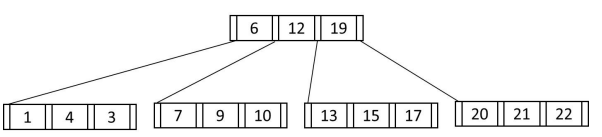
Consider the following B+ tree with 5 nodes, in which a node can store at most 3 key values. The value 23 is now inserted in the B+ tree. Which of the following options(s) is/are CORRECT?
Explanation:
1. Analyze the Initial State & Max Capacity:
• Each node in this B+ tree can store at most 3 key values.
• Looking at the rightmost leaf node, it currently holds 3 keys: [20, 21, 22]. This leaf node is completely full.
2. Trace the Insertion of Key 23:
• Since 23 is greater than the root keys (6, 12, 19), the B+ tree traversal directs the insertion into the rightmost leaf node.
• Attempting to place 23 into [20, 21, 22] creates a temporary overflow state: [20, 21, 22, 23] (4 keys).
3. Handle the Leaf Node Overflow (Split):
• Because the leaf node exceeds its maximum capacity of 3 keys, it must split into two distinct leaf nodes.
• Typically, the keys are distributed evenly (e.g., 2 keys in the left leaf and 2 keys in the right leaf): [20, 21] and [22, 23].
• The smallest key of the new right split node (22) is copied and pushed up to the parent/root node to act as a separator index.
4. Check the Parent Node Condition:
• The root node currently contains 3 keys: [6, 12, 19]. It is also completely full.
• When the key 22 is pushed up from the leaf split, the root experiences an overflow state: [6, 12, 19, 22].
• This forces the root node to split as well, pushing its middle key (typically 12 or 19 depending on implementation) up to form a brand new root node at a higher level.
5. Evaluate the Structural Consequences:
• Will any node split? Yes, both the leaf node and the root node split. Therefore, Statement (a) is False and Statement (b) is True.
• Will the total number of nodes remain the same? No, splitting nodes increases the total count of nodes in the system. Therefore, Statement (c) is False.
• Will the height of the tree increase? Yes, since the root node splits and pushes a key up to create a new top-level root, the overall height of the tree increases by 1 layer.
Note: Since both (b) and (d) are analytically correct for a standard structural push-up split, option (b) directly captures the guaranteed initial cascading behavior required by the insertion algorithm.
Ques 26 GATE 2025 SET-1
Consider two relations describing teams and players in a sports league:
• teams (tid, tname): tid, tname are team-id and team-name, respectively
• players (pid, pname, tid): pid, pname, and tid denote player-id, player-name and the team-id of the player, respectively
Which ONE of the following tuple relational calculus queries returns the name of the players who play for the team having tname as 'MI'?
Explanation:
To retrieve the names of players who belong to a specific team, our Tuple Relational Calculus (TRC) query needs to filter, join, and project attributes across both relations correctly. Let's break down the required logic step-by-step:
1. Determine the Target Variable:
We want to return the names of the players (pname). The main tuple variable bounding this output attribute must belong to the players relation. Therefore, the query must start with:
{ p.pname | p ∈ players ∧ ... }
This immediately eliminates choices (b) and (d), which incorrectly state that p ∈ teams.
2. Establish the Cross-Relation Link (Join Condition):
To find team details corresponding to a player, there must exist a tuple t in the teams relation (∃t (t ∈ teams)) such that the team identifier matches the player's team identifier. This is the explicit join condition:
p.tid = t.tid
3. Apply the Filter Criteria:
We only care about the specific team where the team name matches 'MI':
t.tname = 'MI'
4. Evaluate the Remaining Options:
• Option (a): Correctly specifies that p is a tuple from players, asserts that there exists a tuple t in teams, links them via their shared foreign key (p.tid = t.tid), and applies the exact string filter on the team name.
• Option (c): Missing the critical join constraint p.tid = t.tid. Without this condition, it creates a Cartesian product—returning the names of all players in the database as long as a team named 'MI' exists anywhere in the teams table.
5. Conclusion:
Option (a) is the only syntactically and logically sound TRC formulation for this request.

Total Unique Visitors