Chemical Engineering Gate Yearwise
Chemical Eng. Gate 2025
Chemical Eng. Gate 2024
Chemical Eng. Gate 2023
Chemical Eng. Gate 2022
Chemical Eng. Gate 2021
Chemical Eng. Gate 2020
Chemical Eng. Gate 2019
Chemical Eng. Gate 2018
Chemical Eng. Gate 2017
Chemical Eng. Gate 2016
Chemical Eng. Gate 2015
Chemical Eng. Gate 2014
Chemical Eng. Gate 2013
Chemical Eng. Gate 2012
Chemical Eng. Gate 2011
Chemical Eng. Gate 2010
Chemical Engineering Gate 2015 Questions with Answer
Ques 40 GATE 2015
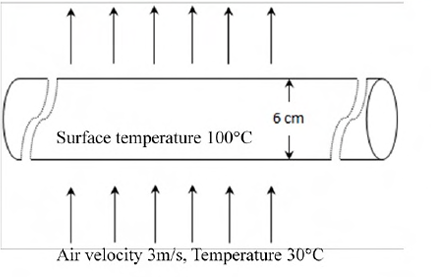
Air is flowing at a velocity of 3 m/s perpendicular to a long pipe as shown in the figure below. The outer diameter of the pipe is d = 6 cm and temperature at the outside surface of the pipe is maintained at 100 °C. The temperature of the air far from the tube is 30 °C. Data for air: Kinematic viscosity, ν = 18×10-6 m²/s; Thermal conductivity, k = 0.03 W/(m·K). Using the Nusselt number correlation: Nu = (h d)/k = 0.024× Re0.8, the rate of heat loss per unit length (W/m) from the pipe to air (up to one decimal place) is _______.
Ques 41 GATE 2015
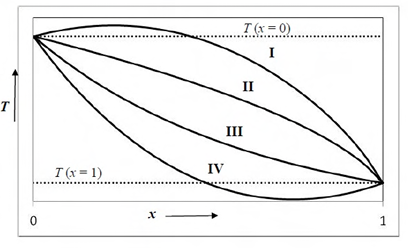
Consider a solid block of unit thickness for which the thermal conductivity decreases with an increase in temperature. The opposite faces of the block are maintained at constant but different temperatures: T(x=0)>T(x=1). Heat transfer is by steady state conduction in x-direction only. There is no source or sink of heat inside the block. In the figure below, identify the correct temperature profile in the block.
Ques 42 GATE 2015
Which one of the following transfer functions, upon a unit step change in disturbance at t = 0, will show a stable time domain response with a negative initial slope (i.e., slope at t=0):
Ques 43 GATE 2015
The block diagram for a process with feedback control for output deviation variable h is shown in the figure below. All transfer functions are given with pre-factor of s in minutes. A unit step change is made in the set-point at t=0. The time required for h to reach 50% of its ultimate value, in minutes (up to two decimal places), is: _______

Ques 44 GATE 2015
Consider a control system with the open loop transfer function given by: GOL(s) = Kce-0.3s / (1.5s+1) In the above function, pre-factor of s is in minutes and Kc is the gain of proportional controller. The frequency for phase margin of 30° is 4.04 rad/min. The value of Kc for a gain margin of 1.7 (up to one decimal place) is _______.
Ques 45 GATE 2015
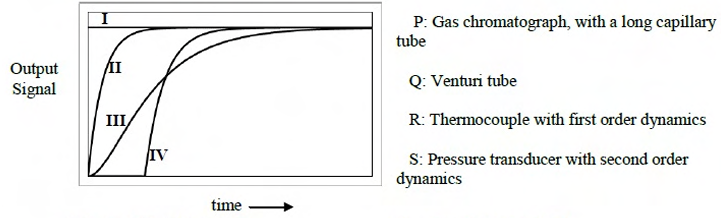
Match the impulse response to a tracer pulse experiment for a flow reactor with the corresponding equipment.
Ques 46 GATE 2015
The transfer function for the disturbance response in an open-loop process is given by Gdopen(s). The corresponding transfer function for the disturbance response in a closed-loop feedback control system with proportional controller is given by Gdclosed(s) Select the option that is ALWAYS correct {O[G(s)] represents order of transfer function G(s)}
Ques 47 GATE 2015
Consider a steady state mass transfer process between well-mixed liquid and vapour phases of a binary mixture comprising of components A and B. The mole fractions of component A in the bulk liquid (xA) and bulk vapour (yA) phases are 0.36 and 0.16, respectively. The mass transfer coefficients for component A in liquid and vapour phases are 0.1 mol/(m2.s) and 0.05 mol/(m2.s), respectively. The vapour-liquid equilibrium can be approximated as yA* = 2xA for xA less than 0.4. The mole fraction of A in the liquid at the interface (up to two decimal places) is _______.
Ques 48 GATE 2015
Adsorption on activated carbon is to be used for reducing phenol concentration in wastewater from 0.04 mol/l to 0.008 mol/l. The adsorption isotherm at the operating temperature can be expressed as q = 0.025C1/3; where q is the phenol concentration in solid (mol/g solid) and C is the phenol concentration in water (mol/l). The minimum amount of solid (in grams) required per liter of wastewater (up to one decimal place) is _______.
Ques 49 GATE 2015
For a binary mixture of components A and B, NA and NB denote the total molar fluxes of components A and B, respectively. JA and JB are the corresponding molar diffusive fluxes. Which of the following is true for equimolar counter-diffusion in the binary mixture?
Ques 50 GATE 2015
Benzene is removed from air by absorbing it in a non-volatile wash-oil at 100 kPa in a counter-current gas absorber. Gas flow rate is 100 mol/min, which includes 2 mol/min of benzene. The flow rate of wash-oil is 50 mol/min. Vapor pressure of benzene at the column conditions is 50 kPa. Benzene forms an ideal solution with the wash-oil and the column is operating at steady state. Gas phase can be assumed to follow ideal gas law. Neglect the change in molar flow rates of liquid and gas phases inside the column. For this process, the value of the absorption factor (up to two decimal places) is _______.
Ques 51 GATE 2015
A spherical naphthalene ball of 2 mm diameter is subliming very slowly in stagnant air at 25°C. The change in the size of the ball during the sublimation can be neglected. The diffusivity of naphthalene in air at 25°C is 1.1×10^{-6} m²/s. The value of mass transfer coefficient is B × 10^{-3} m/s, where B (up to one decimal place) is _______.
Ques 52 GATE 2015
Identify the WRONG statement amongst the following

Total Unique Visitors