Aerospace Engineering Gate Yearwise
Aerospace Gate 2025
Aerospace Gate 2024
Aerospace Gate 2023
Aerospace Gate 2022
Aerospace Gate 2021
Aerospace Gate 2020
Aerospace Gate 2019
Aerospace Gate 2018
Aerospace Gate 2017
Aerospace Gate 2016
Aerospace Gate 2015
Aerospace Gate 2014
Aerospace Gate 2013
Aerospace Gate 2012
Aerospace Gate 2011
Aerospace Gate 2010
Aerospace Gate 2009
Aerospace Engineering Gate 2026 Questions with Answer
Ques 1 GATE 2026
The fundamental purpose of the Kutta condition in the thin airfoil theory is ________.
Ques 2 GATE 2026
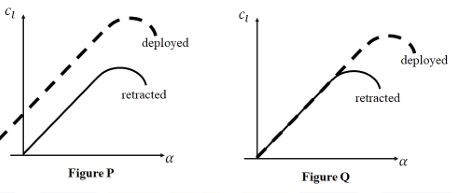
Shown below are qualitative illustrations of the lift curve for an airfoil when two different control surfaces are in their respective retracted and deployed configurations. Which of the following is/are TRUE?
Ques 3 GATE 2026
Which of the following statements is/are TRUE regarding critical and drag divergence Mach numbers of a wing?
Ques 4 GATE 2026
The vortex shedding frequency behind a landing gear model is found to be 50 Hz when tested in a wind tunnel operating at 5 m/s. If the actual landing gear size is 10 times that of the model, and it is designed to operate at 50 m/s, then the expected vortex shedding frequency behind it is ________ Hz (rounded off to the nearest integer).
Ques 5 GATE 2026
An elliptic wing has a span of 6 m and a planform area of 6 m2. When generating a lift coefficient of 0.6, the induced drag it incurs is ________ × 10−3 (rounded off to 1 decimal place).
Ques 6 GATE 2026
An experimental study is planned to map out the low-Reynolds number incompressible steady two-dimensional aerodynamic characteristics of a promising novel airfoil. The operational parameters of the problem are the speed, density and viscosity of the freestream, the chord of the airfoil and its angle of attack. If the objective is to achieve this with the minimum number of test runs Nmin while taking 10 equally-spaced test values of each independent parameter of the problem in a suitable range, then Nmin is ________.
Ques 7 GATE 2026
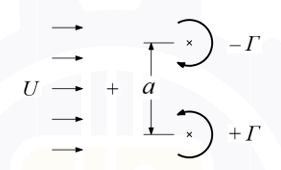
Consider the flow over an oval modeled using the elementary potential flows as shown below. U represents uniform flow velocity and Γ represents circulation around an irrotational line vortex.
Which of the following statements is/are TRUE for this model?
Ques 8 GATE 2026
What is/are the use(s) of the single horseshoe vortex model of finite wing aerodynamic theory?
Ques 9 GATE 2026
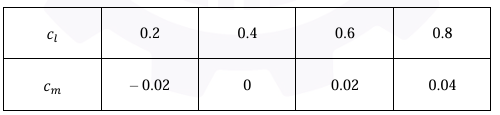
For an airfoil section the pitching moment coefficient is determined about a reference point that is 0.3 times the chord behind the leading edge. It varies with the lift coefficient as shown in the table below. The distance of the aerodynamic center from the leading edge of the airfoil as a fraction of the chord is ________ (rounded off to one decimal place).
Ques 10 GATE 2026
Consider a finite wing of aspect ratio 10 with span effectiveness factor 0.95. Its airfoil section has a lift slope of 0.106 per degree and a zero-lift angle of attack of –1.5°. The lift coefficient of the wing at an angle of attack of 3.5° is ________ (rounded off to 2 decimal places).
Ques 11 GATE 2026
Thin airfoil theory predicts the zero-lift angle of attack αL=0 of NACA 2412 airfoil as −2.1°. The corresponding prediction of αL=0 for NACA 5410 airfoil is ________ degrees (rounded off to 1 decimal place).
Ques 12 GATE 2026
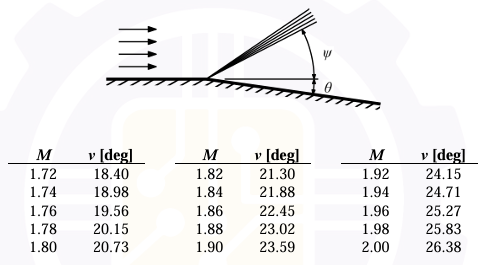
Consider a centered Prandtl-Meyer expansion fan at a θ = 4° corner in a Mach 1.78 air flow, as shown in the figure below. The angle ψ (see figure) made by the ending wave of the fan with respect to the incoming stream is ________ degrees (rounded off to 1 decimal place).
An excerpt from the table of Prandtl-Meyer function for air is provided below.
Ques 13 GATE 2026
A Mach 1.5 air flow enters a round duct of length 20 cm and diameter 3 cm. If the flow exits with Mach number 1.1, the average Fanning friction factor f of the duct is ________ × 10−3 (rounded off to 1 decimal place).
An excerpt from the Fanno flow table for air is given below.


Total Unique Visitors