Chemical Engineering Gate Yearwise
Chemical Eng. Gate 2025
Chemical Eng. Gate 2024
Chemical Eng. Gate 2023
Chemical Eng. Gate 2022
Chemical Eng. Gate 2021
Chemical Eng. Gate 2020
Chemical Eng. Gate 2019
Chemical Eng. Gate 2018
Chemical Eng. Gate 2017
Chemical Eng. Gate 2016
Chemical Eng. Gate 2015
Chemical Eng. Gate 2014
Chemical Eng. Gate 2013
Chemical Eng. Gate 2012
Chemical Eng. Gate 2011
Chemical Eng. Gate 2010
Chemical Engineering Gate 2026 Questions with Answer
Ques 53 GATE 2026
In a certain project, 15% of the total investment is the working capital. The minimum acceptable rate of return is 4.95% and the period of evaluation is 15 years. Which one of the following is the maximum acceptable project payback period (in years)?
Ques 54 GATE 2026
Consider three identical non-interacting first order processes in series, each having unit gain and a time constant of 2 min. Tuning of proportional controller using closed loop Ziegler-Nichols technique is considered. Which one of the following is the ultimate period of sustained cycling (in min per cycle)?
Ques 55 GATE 2026
A thermometer initially at a steady temperature of 30 °C is inserted in a water bath maintained at 90 °C. The initial rate of temperature rise of the thermometer is 2 °C s−1. Assuming first order behavior, the thermometer reading (in °C) after one minute is ______ (rounded off to one decimal place).
Ques 56 GATE 2026
A process exhibits an inverse response to a step input. Which of the following statements is/are necessarily TRUE about the process?
Ques 57 GATE 2026
A control valve with hyperbolic characteristics has a turndown ratio (ratio of maximum flow to minimum controllable flow) of 50. The flow rate through the valve at 70% open is 5 m3 s−1. Assuming constant fluid density and pressure drop across the valve, which one of the following is the flow rate (in m3 s−1) through the valve at 30% open?
Ques 58 GATE 2026
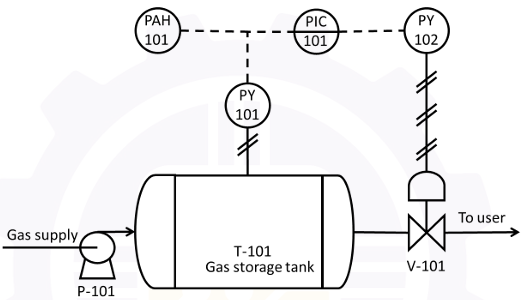
In the P&ID shown below, which one of the following is the function of PAH in the process? (P&ID shows PAH-101, PIC-101, PY-101, PY-102 connected to a gas storage tank T-101 with pump P-101 and valve V-101)
Ques 59 GATE 2026
A first-order homogeneous liquid-phase reaction (A→B) occurs in an adiabatic, ideal mixed flow reactor operating at steady state. The volumetric flow rate of the feed is 4 L min−1 and volume of the reactor is 20 L. At the reactor temperature of 500 K, the reaction rate constant is 1 min−1, and heat of reaction is −20 kcal mol−1. The average heat capacity of the feed as well as the reaction mixture in the temperature range of interest is 0.3 kcal mol−1 K−1.
At the inlet, the feed temperature (in K) is _________ (rounded off to one decimal place).
Ques 60 GATE 2026
A first-order homogeneous liquid-phase reaction (A→B) occurs in a non-ideal isothermal reactor operating at steady state. The variance (σ2) of residence time distribution (RTD) from a pulse tracer experiment is 4 min2. The volumetric flow rate of the feed is 5 L min−1 and volume of the reactor is 25 L. The reaction rate constant is 0.4 min−1. Based on the tanks-in-series model, the conversion (in %) is _______ (rounded off to one decimal place).
Ques 61 GATE 2026
An irreversible chemical reaction occurs on a porous catalyst. All the pores are of same size. In strong pore diffusion regime, the observed activation energy is 120 kJ mol−1. The activation energy of diffusion is 10 kJ mol−1. Assuming Arrhenius temperature dependency for both reaction and diffusion, which one of the following is the true activation energy (in kJ mol−1) of the reaction?
Ques 62 GATE 2026
For an irreversible reaction containing inerts in the feed, single-pass conversion in a reactor is 70%. Which one of the following statements is CORRECT?
Ques 63 GATE 2026
Consider a homogeneous gas phase reaction, A + 2B → 2C + 3D, occurring at constant temperature and pressure in a varying volume batch reactor. The vessel is initially charged with 50 moles of A and 150 moles of B. The gases behave ideally. For complete conversion of A, the ratio of the final volume to the initial volume is ______ (rounded off to one decimal place).
Ques 64 GATE 2026
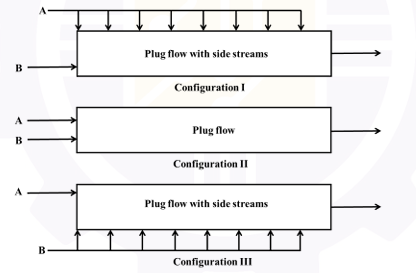
Consider the following homogeneous isothermal liquid-phase parallel reactions carried out in three reactor configurations (having identical volumes and same operating temperatures), as shown in the figure.
A + B → D Rate of formation of D: rD = k1CACB
A + B → U Rate of formation of U: rU = k2CA2CB
where D is the desired product and U is the undesired product. The inlet concentrations of A and B are the same in all three configurations (CA0 = CB0 = 1 mol L−1). The total molar feed flow rate of A (FA0) and that of B (FB0) are the same in all three configurations (FA0 = FB0 = 10 mol min−1). In configuration I, FA0 is equally distributed among all the inlets. Similarly, in configuration III, FB0 is equally distributed among all the inlets. Assuming plug flow behavior, at steady state, which one of the following statements is CORRECT?
Ques 65 GATE 2026
The reaction rate constants of two reactions follow Arrhenius' law. The activation energies of Reaction 1 and Reaction 2 are E1 and E2, respectively and E1 < E2. Assuming same value for the frequency factor for both the reactions, which one of the following statements is CORRECT?

Total Unique Visitors