Agricultural Engineering Gate Yearwise
Agricultural Gate 2025
Agricultural Gate 2024
Agricultural Gate 2023
Agricultural Gate 2022
Agricultural Gate 2021
Agricultural Gate 2020
Agricultural Gate 2019
Agricultural Gate 2018
Agricultural Gate 2017
Agricultural Gate 2016
Agricultural Gate 2015
Agricultural Gate 2014
Agricultural Gate 2013
Agricultural Engineering Gate 2018 Questions with Answer
Ques 53 GATE 2018
One of the key assumptions made by Dupuit-Forchheimer about the flow behavior in the porous medium towards subsurface drains is
Ques 54 GATE 2018
The depths from the soil surface to subsurface tile drains, impermeable soil layer and the highest water table are measured as 2.8 m, 5.0 m and 0.8 m, respectively. The effective hydraulic head for drainage in meter is
Ques 55 GATE 2018
The discharge from a sprinkler nozzle depends on
Ques 56 GATE 2018
The porosity and compressibility of a 7.8 m thick confined aquifer are 0.25 and 1×10⁻⁸ m2 N-1, respectively. The storage coefficient of the aquifer is 6.5×10⁻⁴. To release 650 m3 of water from 1 km2 of this aquifer, the average decline in hydraulic head will be
Ques 57 GATE 2018
The drawdown at the well face of a 30 cm diameter fully penetrating well in a confined aquifer is 3 m. The radius of influence of this well is 3 km. For the same discharge and aquifer condition, the drawdown at 300 m away from the centre of the well is
Ques 58 GATE 2018
A permanent matured orchard has a tree spacing of 4 m×5 m. Each tree has a shading area of 40% to be irrigated with the ‘pig tail’ pattern multi-exit drip emitters. The effective wetting geometry of each emitter is 2 m×2 m. The emitters have discharge constant and exponent of 0.3 and 0.6, respectively. The coefficient of variation of emitter discharge is 0.06. The average and minimum operating pressures are 120 kPa and 100 kPa, respectively. The emission uniformity of the emitters is
Ques 59 GATE 2018
The 6-hour unit hydrograph of a watershed is represented by an isosceles triangle with the peak of 180 m3 s-1 and time to peak of 18 hours. The phi-index (∅) of this watershed is 3.0 mm h-1 and the constant baseflow is 20 m3 s-1. The accumulated rainfall received in this watershed at 6 h and 12 h from the start of the storm are 38 mm and 106 mm, respectively. The resulting peak of the flood hydrograph due to this storm event is
Ques 60 GATE 2018
Three geometrically identical Lysimeters (A, B and C) installed in a paddy field have uniform initial ponding depths of 12 cm. After a week, the recorded water depths in A, B and C are 10.4 cm, 8.6 cm, and 7.0 cm, respectively. Rainfall received during this week is 15 mm, and the crop coefficient of paddy is 0.94. Lysimeter ‘A’ has a closed bottom with no plant. Lysimeter ‘B’ has an open bottom with no plant. Lysimeter ‘C’ has an open bottom with paddy plants. Neglecting the boundary effects and groundwater contribution in the Lysimeters, the weekly potential evapotranspiration will be
Ques 61 GATE 2018
Furrows of 120 m length with 0.5% slope are made at 90 cm spacing. The maximum non-erosive stream flow rate is applied in a furrow that takes 1.0 hour to reach the lower end. Then this flow rate is reduced to half of its size and, subsequently, continued for another 1.0 hour. The average depth of applied water is
Ques 62 GATE 2018
Match the following items of Column I with the corresponding items of
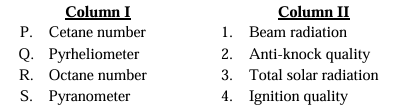
Ques 63 GATE 2018
Constituents of the producer gas contributing to its heating value are
Ques 64 GATE 2018
A 2 m3 biogas plant is to be operated using cow-dung as feedstock. The cow-dung is mixed with water in proportion of 1:1 (by weight) to form a slurry of density 1090 kg m-3. The yield of biogas is 0.036 m3 kg-1 of cow-dung. If the hydraulic retention time is 40 days, volume of the digester of the biogas plant will be
Ques 65 GATE 2018
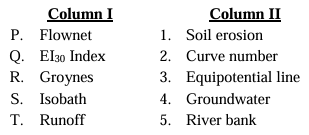
Match the following items in Column I with the corresponding items in Column II:

Total Unique Visitors