Analytical Reasoning
Blood Relationship Coding-Decoding Direction Sense Ranking and Order Alphabet Test Series CompletionVerbal Reasoning
Analogy Classification Word Formation Statement and Conclusion Syllogism Cause and EffectArrangement & Pattern
Seating Arrangement Puzzle Test Input-Output Sequential Pattern Number Series Missing NumberVisual Reasoning
Mirror Images Water Images Paper Folding Paper Cutting Figure Matrix Rule DetectionMathematical Logic
Calendar Clock Venn Diagrams Mathematical Operations Cube and Dice Logical SequencePaper Folding Aptitude Questions & Formulas with answer
Ques 1 GATE 2025 SET-1
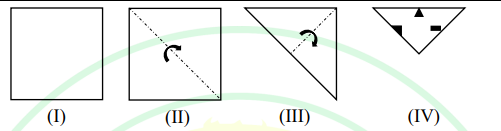
A square paper, shown in figure (I), is folded along the dotted lines as shown in the figures (II) and (III). Then a few cuts are made as shown in figure (IV). Which one of the following patterns will be obtained when the paper is unfolded?
Note: The figures shown are representative.
(a) is the correct answer.
Explanation:
1. Analyze the Folding Process:
• Step 1 (Figure II): The square paper is folded diagonally from the top-left to the bottom-right corner. The upper-right half is flipped down over the bottom-left half.
• Step 2 (Figure III): The resulting triangle is folded in half again along a line from the top-right corner down to the longest edge (the main diagonal crease). The left corner is flipped over to the right, forming a smaller, inverted right-angled isosceles triangle shown in Figure (IV).
2. Analyze the Cuts in Figure (IV):
• Triangle cut: Placed along the upper, horizontal edge. This edge represents the outer boundaries of the original square paper (specifically, the top and right outer edges).
• L-shaped cut: Placed on the left edge of the triangle, which lies directly on the main diagonal crease of the square.
• Rectangle/Square cut: Placed on the right edge, which represents the secondary crease inside the paper.
3. Trace the Unfolding of the Triangle Cut:
• The triangle cut is on the outer horizontal edge. When the paper is unfolded completely, this edge unfolds onto all four outer borders of the square.
• Since the tip of the triangle punch points upward (out of the paper's edge), unfolding it creates a single triangular notch on each outer edge with its apex pointing toward the center of the square.
• Looking closely at the top and bottom edges of the options: in (a) and (b), the top triangle points up (outward) and the bottom triangle points down (outward). In (c), they point inward. Therefore, (c) is eliminated.
4. Trace the Unfolding of the L-Shaped Cut:
• The L-shaped punch is placed on the left side of the triangle in Figure (IV). This side maps directly to the diagonal crease running from the top-left corner to the bottom-right corner of the original square.
• Unfolding an L-shape over a line of symmetry creates an asymmetric or corner-like punch. Specifically, it forms two separate corner hooks facing each other along the diagonal axis (one in the top-right corner region and one in the bottom-left corner region).
• This matches options (a), (b), and (c) perfectly.
5. Trace the Unfolding of the Rectangle Cut:
• The small horizontal rectangle is punched on the right side of the triangle in Figure (IV).
• When unfolded across the secondary crease line, the rectangle mirrors perfectly to form a small, standard square oriented parallel to the square's outer edges.
• Crucially, when the paper is unfolded completely, these shapes land in the top-left and bottom-right quadrants. Because the original cut was purely horizontal and vertical, it remains a standard square (■). It does not tilt to become a diamond (◆).
• This eliminates option (b) (which shows diamonds) and leaves option (a) as the only correct arrangement.
6. Conclusion: Option (a) precisely matches the geometry of all unfolded cuts.
Ques 2 GATE 2025
The given figure is reflected about the horizontal dashed line and then rotated clockwise by 90° about an axis perpendicular to the plane of the figure.
Which one of the following options correctly shows the resultant figure?
Note: The figures shown are representative.

(a) is the correct answer.