Textile Engineering > GATE 2017 > Analytical Reasoning
The growth of bacteria (lactobacillus) in milk leads to curd formation. A minimum bacterial population density of 0.8 (in suitable units) is needed to form curd. In the graph below, the population density of lactobacillus in 1 litre of milk is plotted as a function of time, at two different temperatures, 25°C and 37°C.
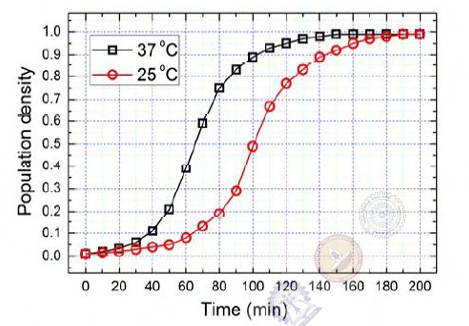 Consider the following statements based on the data shown above:
i. The growth in bacterial population stops earlier at 37°C as compared to 25°C
ii. The time taken for curd formation at 25°C is twice the time taken at 37°C
Which one of the following options is correct?
i. The growth in bacterial population stops earlier at 37°C as compared to 25°C
ii. The time taken for curd formation at 25°C is twice the time taken at 37°C
Which one of the following options is correct?
Correct : a
Similar Questions
Inhaling the smoke from a burning _________ could _________ you quickly.
A sphere of radius 𝑟 cm is packed in a box of cubical shape.
What should be the minimum volume (in cm3) of the box that can enclose the
sphere?
Pipes P and Q can fill a storage tank in full with water in 10 and 6 minutes,
respectively. Pipe R draws the water out from the storage tank at a rate of 34
l...

Total Unique Visitors
Loading......