Electrical Engineering > GATE 2016 SET-2 > Inverters
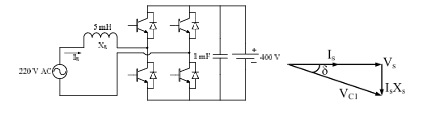
A single-phase bi-directional voltage source converter (VSC) is shown in the figure below. All devices are ideal. It is used to charge a battery at 400 V with power of 5 kW from a source Vs=220 V (rms), 50 Hz sinusoidal AC mains at unity p.f. If its AC side interfacing inductor is 5 mH and the switches are operated at 20 kHz, then the phase shift (δ) between AC mains voltage (Vs) and fundamental AC rms VSC voltage (VC1), in degree, is ________.
Correct : 18.35
Similar Questions
A single-phase full bridge voltage source inverter (VSI) feeds a purely inductive load. The inverter output voltage is a square wave in 180° conduction mode. Th...
A single-phase full-bridge inverter fed by a 325 V DC produces a symmetric quasi-square waveform across 'ab' as shown. To achieve a modulation index of 0.8, the...
A single-phase inverter is fed from a 100 V de source and is controlled using a quasi-square wave modulation scheme to produce an output waveform, v(t), as show...

Total Unique Visitors
Loading......