EC > GATE 2017 SET-1 > Power Spectral Density
Let X(t) be a wide sense stationary random process with the power spectral density SX(f) as shown in Figure (a), where f is in Hertz (Hz). The random process X(t) is input to an ideal lowpass filter with the frequency response
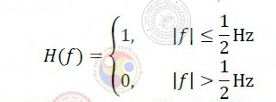 as shown in Figure (b). The output of the lowpass filter is Y(t).
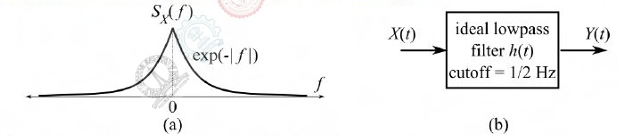 Let E be the expectation operator and consider the following statements:
I. E(X(t))=E(Y(t))
II. E(X2(t))=E(Y2(t))
III. E(Y2(t))=2
Select the correct option:
I. E(X(t))=E(Y(t))
II. E(X2(t))=E(Y2(t))
III. E(Y2(t))=2
Select the correct option:
Correct : a
Similar Questions
For a real signal, which of the following is/are valid power spectral density/densities?
Let a random process Y(t) be described as Y(t)=h(t)*X(t)+Z(t), where X(t) is a white noise process with power spectral density Sx(f)=5 W/Hz. The filter h(t)...
Consider a white Gaussian noise process N(t) with two-sided power spectral density SN(f)=0.5 W/Hz as input to a filter with impulse response 0.5e-t2/2 (where t...

Total Unique Visitors
Loading......