EC > GATE 2014 SET-4 > Laplace Transform
A causal LTI system has zero initial conditions and impulse response h(t). Its input x(t) and output y(t) are related through the linear constant-coefficient differential equation
d2y(t)/dt2 + α(dy(t)/dt) + α2y(t) = x(t).
Let another signal g(t) be defined as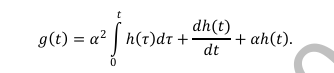 If G(s) is the Laplace transform of g(t), then the number of poles of G(s) is _____.
d2y(t)/dt2 + α(dy(t)/dt) + α2y(t) = x(t).
Let another signal g(t) be defined as
Correct : 1
Similar Questions
Let Y(s) be the unit-step response of a causal system having a transfer function G(s)=(3-s)/((s+1)(s+3)), that is, Y(s)=G(s)/s. The forced response of the syste...
The transfer function of a causal LTI system is H(s)=1/s. If the input to the system is x(t)=[sin(t)/πt]u(t), where u(t) is a unit step function. the syste...
The Laplace transform of the causal periodic square wave of period T shown in the figure below is

Total Unique Visitors
Loading......