Note: One input combination is an instance of [A B S1 S0].
Correct : 5
he correct answer is 6.
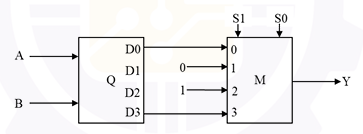
The circuit consists of a 2×4 decoder (inputs A, B) feeding a 4-to-1 multiplexer M with select lines S1 and S0. The MUX data inputs are wired as: I0 = AB̄, I1 = AB̄ (or tied), I2 = 1 (always high), I3 = AB.
Case 1 - S1S0 = 10 (selects I2 = 1): Output y = 1 regardless of A and B. Since A and B can each be 0 or 1 independently, this gives 4 combinations: (0,0,1,0), (0,1,1,0), (1,0,1,0), (1,1,1,0).
Case 2 - S1S0 = 00 (selects I0 = AB̄): Output y = 1 only when AB̄ = 1, i.e., A=0, B=0. This gives 1 combination: (0,0,0,0).
Case 3 - S1S0 = 11 (selects I3 = AB): Output y = 1 only when AB = 1, i.e., A=1, B=1. This gives 1 combination: (1,1,1,1).
Case 4 - S1S0 = 01 (selects I1): The MUX input I1 corresponds to the decoder output D1 = AB̄ (which is 0 for all A,B combinations in standard 2×4 decoder with active-high outputs where only one line is high). y = 0 for all A,B. 0 combinations.
Total combinations = 4 + 1 + 1 = 6.
Similar Questions

Total Unique Visitors