Correct : c,d
The correct answers are Option C and Option D.
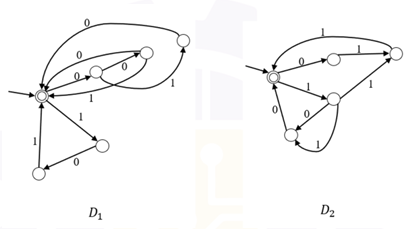
The DFAs D1 and D2 are defined over the alphabet Σ = {0,1}, and each accepts strings formed by concatenating specific 3-bit blocks.
L(D1) consists of strings formed using blocks like 000, 001, 010, 101.
L(D2) consists of strings formed using the remaining blocks like 011, 100, 110, 111.
Option A is false:
L(D1) ≠ L(D2). For example, “000” is accepted by D1 but not by D2, while “011” is accepted by D2 but not by D1.
Option B is false:
Neither language is a subset of the other, since each accepts strings that the other does not.
Option C is true:
The 3-bit blocks used in D1 and D2 are disjoint. So, no non-empty string can belong to both languages. The only common string is the empty string ε.
Hence, L(D1) ∩ L(D2) = {ε}.
Option D is true:
The union L(D1) ∪ L(D2) contains all possible 3-bit strings. Repeating these blocks any number of times (including zero) generates all strings whose length is a multiple of 3.
Hence, (L(D1) ∪ L(D2)* ) generates all strings over {0,1} with length divisible by 3.
Similar Questions

Total Unique Visitors