HK(S) = max(S − K, 0). The max function is defined as:
max(a, b) = a when a > b; b when a ≤ b.
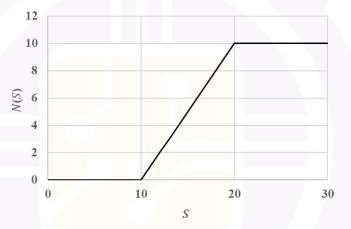
The graph below shows the plot of a function N(S) versus S. N(S) can be expressed as ______.
Correct : a
From the graph, N(S) has three distinct regions:
N(S) = 0 for S ≤ 10, rises linearly from 0 to 10 for 10 < S ≤ 20, and stays flat at 10 for S > 20.
The key insight is to recognise this as a bull spread payoff — starting from zero, rising with slope 1, then capping out. This is exactly what you get when you subtract two call option payoffs with different strike prices.
Evaluating H10(S) − H20(S) across all three regions:
For S ≤ 10: H10(S) = 0 and H20(S) = 0, so N(S) = 0 − 0 = 0. Matches the flat zero section ✓
For 10 < S ≤ 20: H10(S) = S − 10 and H20(S) = 0, so N(S) = (S − 10) − 0 = S − 10. At S=10 this gives 0 and at S=20 this gives 10 — matches the rising section with slope 1 ✓
For S > 20: H10(S) = S − 10 and H20(S) = S − 20, so N(S) = (S−10) − (S−20) = 10. Matches the flat cap at 10 ✓
Options B, C, and D all fail to match the graph in at least one region — B gives a decreasing value beyond S=20, C gives negative values between S=10 and S=20, and D starts rising only at S=15 instead of S=10.
Correct answer: A — H10(S) − H20(S) ✓
Similar Questions

Total Unique Visitors