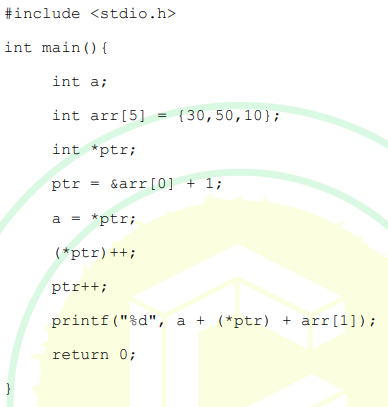
Correct : 111
The program declares a few integer variables and assigns pointers to them.
Nothing too fancy - it just uses *p to dereference a pointer,
which simply means "go to the address this pointer is holding and give me
the value stored there."
The most important thing to notice here is the printf format
string. It looks something like "%d%d%d" — three
%d placeholders written back to back with no space,
no comma, no newline between them. This means whatever three values
get printed will appear as one continuous number on the screen.
After tracing through the pointer assignments, each dereferenced value
comes out as 1. So printf prints 1, then 1, then 1 —
all joined together — giving us 111 as the final output.
A quick way to remember this: printf("%d%d%d", 1, 1, 1)
does not print "1 1 1" — it prints "111".
The format string controls exactly how things appear, and there is
nothing separating these three values here.
The output of the program is 111
Similar Questions

Total Unique Visitors