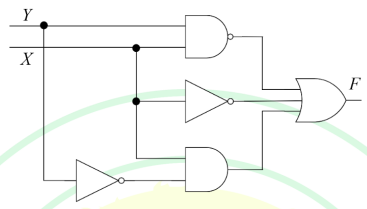
Correct : a
The correct answer is Option A - XȲ.
The logic circuit produces an output F that is 1 only when X = 1 and Y = 0. Tracing the circuit through its gates gives F = X · Ȳ - X AND (NOT Y).
Let''s verify using a truth table:
X=0, Y=0: XȲ = 0·1 = 0
X=0, Y=1: XȲ = 0·0 = 0
X=1, Y=0: XȲ = 1·1 = 1
X=1, Y=1: XȲ = 1·0 = 0
Now check the other options against this truth table:
Option B - X̄ + Ȳ + XȲ: By absorption, XȲ is redundant under Ȳ, giving X̄ + Ȳ. This is 1 for (0,0), (0,1), (1,0) — three rows, not just one. Incorrect.
Option C - X̄Ȳ + X̄ + XȲ: Simplifies to X̄ + XȲ = X̄ + Ȳ. Same as B - too many 1s. Incorrect.
Option D - X + Ȳ: This is 1 for (1,0), (1,1), (0,0) — again too broad. Incorrect.
Only Option A matches the circuit output exactly.
Similar Questions

Total Unique Visitors