Note: The figures shown are representative.
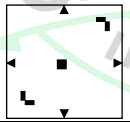
Correct : a
Explanation:
1. Analyze the Folding Process:
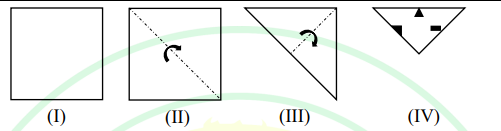
• Step 1 (Figure II): The square paper is folded diagonally from the top-left to the bottom-right corner. The upper-right half is flipped down over the bottom-left half.
• Step 2 (Figure III): The resulting triangle is folded in half again along a line from the top-right corner down to the longest edge (the main diagonal crease). The left corner is flipped over to the right, forming a smaller, inverted right-angled isosceles triangle shown in Figure (IV).
2. Analyze the Cuts in Figure (IV):
• Triangle cut: Placed along the upper, horizontal edge. This edge represents the outer boundaries of the original square paper (specifically, the top and right outer edges).
• L-shaped cut: Placed on the left edge of the triangle, which lies directly on the main diagonal crease of the square.
• Rectangle/Square cut: Placed on the right edge, which represents the secondary crease inside the paper.
3. Trace the Unfolding of the Triangle Cut:
• The triangle cut is on the outer horizontal edge. When the paper is unfolded completely, this edge unfolds onto all four outer borders of the square.
• Since the tip of the triangle punch points upward (out of the paper's edge), unfolding it creates a single triangular notch on each outer edge with its apex pointing toward the center of the square.
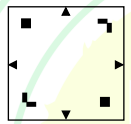
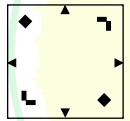
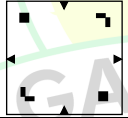
• Looking closely at the top and bottom edges of the options: in (a) and (b), the top triangle points up (outward) and the bottom triangle points down (outward). In (c), they point inward. Therefore, (c) is eliminated.
4. Trace the Unfolding of the L-Shaped Cut:
• The L-shaped punch is placed on the left side of the triangle in Figure (IV). This side maps directly to the diagonal crease running from the top-left corner to the bottom-right corner of the original square.
• Unfolding an L-shape over a line of symmetry creates an asymmetric or corner-like punch. Specifically, it forms two separate corner hooks facing each other along the diagonal axis (one in the top-right corner region and one in the bottom-left corner region).
• This matches options (a), (b), and (c) perfectly.
5. Trace the Unfolding of the Rectangle Cut:
• The small horizontal rectangle is punched on the right side of the triangle in Figure (IV).
• When unfolded across the secondary crease line, the rectangle mirrors perfectly to form a small, standard square oriented parallel to the square's outer edges.
• Crucially, when the paper is unfolded completely, these shapes land in the top-left and bottom-right quadrants. Because the original cut was purely horizontal and vertical, it remains a standard square (■). It does not tilt to become a diamond (◆).
• This eliminates option (b) (which shows diamonds) and leaves option (a) as the only correct arrangement.
6. Conclusion: Option (a) precisely matches the geometry of all unfolded cuts.
Similar Questions

Total Unique Visitors