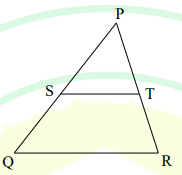
Note: The figure shown is representative.
Correct : a
Explanation:
1. Understand the Given Distance Conditions:
• The shortest distance from a point to a line is the perpendicular height.
• Let the total height of the large triangle PQR (perpendicular distance from P to QR) be H.
• The problem states that the distance between parallel lines ST and QR is half of this total distance. Therefore, the height of the trapezium SQRT is H/2.
• This leaves the remaining height for the small triangle PST to be: H - H/2 = H/2.
2. Use the Property of Similar Triangles:
• Since ST is parallel to QR, triangle PST is similar to triangle PQR (ΔPST ∼ ΔPQR).
• The ratio of the heights of these two similar triangles is:
Height of ΔPST / Height of ΔPQR = (H/2) / H = 1/2
• Since the ratio of their corresponding heights is 1/2, the ratio of their areas must be the square of the scale factor:
Area(ΔPST) / Area(ΔPQR) = (1/2)2 = 1/4
3. Determine the Area Breakdown:
• Let the total area of the large triangle PQR be 4 units.
• Then, the area of the smaller top triangle PST is exactly 1 unit.
• The area of the bottom trapezium SQRT is the remaining area:
Area(Trapezium SQRT) = Area(ΔPQR) - Area(ΔPST) = 4 - 1 = 3 units.
4. Calculate the Required Ratio:
• The question asks for the ratio of the area of triangle PST to the area of trapezium SQRT:
Ratio = Area(ΔPST) / Area(Trapezium SQRT) = 1/3
Similar Questions

Total Unique Visitors