Correct : d
The correct answer is Option D — 64√2 and −64√2.
There's a beautiful shortcut in linear algebra that makes this question very straightforward once you know it — if λ is an eigenvalue of matrix A, then λn is an eigenvalue of An. So instead of computing A13 directly (which would be a nightmare), we just find the eigenvalues of A first and raise them to the power 13.
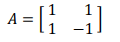
For the given 2×2 matrix A, solving the characteristic equation det(A − λI) = 0 gives us the eigenvalues as √2 and −√2.
Now applying the power property:
Eigenvalue 1 of A13 = (√2)13 = (21/2)13 = 213/2 = 26 × 21/2 = 64√2
Eigenvalue 2 of A13 = (−√2)13 = −(√2)13 = −64√2
The negative sign stays negative because 13 is an odd power — (−1)13 = −1. If the power were even, both eigenvalues would be positive. That's a small but important thing to keep in mind during exams.
So the eigenvalues of A13 are 64√2 and −64√2, which matches Option D perfectly.
The core idea to take away — never try to compute high powers of matrices directly in GATE. Always check if you can use the eigenvalue-power relationship. It saves enormous time and is almost always applicable in such questions.
Similar Questions

Total Unique Visitors