Correct : -2.0
Explanation:
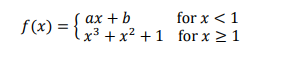
For a piecewise function to be differentiable everywhere, it must meet two conditions at the boundary point where the definition changes (at x = 1): it must be continuous, and its derivative must be continuous.
1. Condition 1: Continuity at x = 1
The Left-Hand Limit (LHL) must equal the Right-Hand Limit (RHL) at x = 1.
• LHL (as x approaches 1 from the left):
LHL = limx→1- (ax + b) = a(1) + b = a + b
• RHL (as x approaches 1 from the right):
RHL = limx→1+ (x3 + x2 + 1) = (1)3 + (1)2 + 1 = 1 + 1 + 1 = 3
Equating the two for continuity gives us our first equation:
a + b = 3 — (Equation 1)
2. Condition 2: Differentiability at x = 1
The derivative of the function from the left must equal the derivative from the right at x = 1.
Let's find the derivative f'(x) for each piece:
• For x < 1: d/dx (ax + b) = a
• For x ≥ 1: d/dx (x3 + x2 + 1) = 3x2 + 2x
Now evaluate both side limits at x = 1:
• Left-Hand Derivative (LHD) = a
• Right-Hand Derivative (RHD) = 3(1)2 + 2(1) = 3 + 2 = 5
Equating LHD and RHD for differentiability directly provides the value of a:
a = 5
3. Solve for b:
Substitute the value of a into Equation 1:
5 + b = 3
b = 3 - 5 = -2
4. Conclusion:
The exact value of b is -2 (written as -2 or -2.0 rounded off to one decimal place).
Similar Questions

Total Unique Visitors