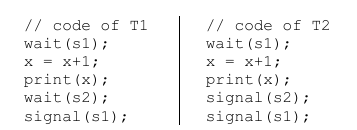
Correct : b,c
Explanation:
Let us analyze the possible execution sequences of threads T1 and T2 based on which thread acquires the shared semaphore s1 (initialized to 1) first.
Case 1: T1 executes first
1. T1 executes wait(s1) successfully (s1 becomes 0).
2. T1 increments x to 1 and prints 1.
3. T1 executes wait(s2). Since s2 = 0, T1 blocks here.
4. If a context switch occurs, T2 tries to execute wait(s1). Since s1 = 0, T2 also blocks.
Both threads are permanently blocked waiting for each other, resulting in a deadlock where only 1 was printed.
→ This validates Option (c).
Case 2: T2 executes first
1. T2 executes wait(s1) successfully (s1 becomes 0).
2. T2 increments x to 1 and prints 1.
3. T2 signals s2 (s2 = 1) and signals s1 (s1 = 1), completing its execution.
4. T1 is now free to run. It passes wait(s1), increments x to 2, and prints 2.
5. T1 passes wait(s2) without blocking because s2 was set to 1 by T2.
Both threads finish successfully, printing 1 followed by 2.
→ This validates Option (b).
Conclusion:
The possible outcomes are b and c.
Similar Questions

Total Unique Visitors