Computer Sciences > GATE 2014 SET-1 > Calculus
Let the function
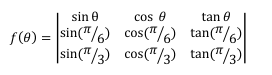 where θ ∈ [π/6, π/3] and f'(θ) denote the derivative of f with respect to θ. Which of the following statements is/are TRUE?
(I) There exists θ ∈ (π/6, π/3) such that f'(θ) = 0
(II) There exists θ ∈ (π/6, π/3) such that f'(θ) ≠ 0
(I) There exists θ ∈ (π/6, π/3) such that f'(θ) = 0
(II) There exists θ ∈ (π/6, π/3) such that f'(θ) ≠ 0
Correct : c
Similar Questions
Consider the functions
I. e-x
II. x2 - sin x
III. √x^3+1
Which of the above functions is/are increasing everywhere in [0, 1] ?
Let f(x) be a continuous function from R to R such that f(x) = 1 - f(2-x) Which one of the following options is the CORRECT value of ∫02f(x)dx?
Let f(x) = x3 + 15x2 - 33x - 36 be a real-valued function. Which of the following statements is/are TRUE?

Total Unique Visitors
Loading......