Correct : c
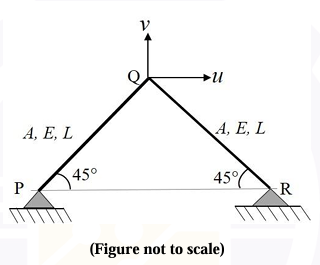
Each truss member contributes to the stiffness matrix at joint Q through the standard expression kelement = (AE/L)[l² lm; lm m²], where l and m are the direction cosines of the member.
Member PQ makes +45° with the horizontal: l = 1/√2, m = 1/√2. Its contribution at Q:
(AE/L) × [1/2, 1/2; 1/2, 1/2]
Member QR makes −45° with the horizontal: l = 1/√2, m = −1/√2. Its contribution at Q:
(AE/L) × [1/2, −1/2; −1/2, 1/2]
Adding both contributions:
K = (AE/L) × [(1/2+1/2), (1/2−1/2); (1/2−1/2), (1/2+1/2)]
= (AE/L) × [1, 0; 0, 1]
The off-diagonal terms cancel because the two members are symmetric about the vertical axis at Q — the horizontal-vertical coupling terms from PQ and QR cancel exactly, leaving a diagonal stiffness matrix. This means horizontal (u) and vertical (v) displacements at Q are fully decoupled.
Correct answer: C — AE/L [1 0; 0 1] ✓
Similar Questions

Total Unique Visitors