Civil Engineering > GATE 2021 SET-1 > Geotechnical Engineering
Based on drained triaxial shear tests on sands and clays, the representative variations of volumetric strain (ΔV/V) with the shear strain (γ) is shown in the figure. 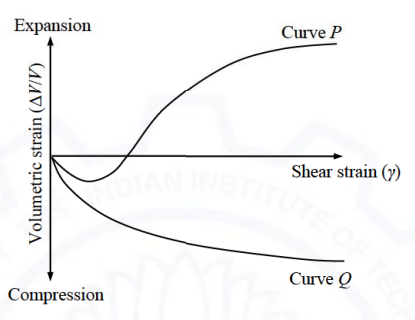 Choose the CORRECT option regarding the representative behaviour exhibited by Curve P and Curve Q.
Correct : a
Similar Questions
Group I lists the type of gain or loss of strength in soils. Group II lists the property or process responsible for the loss or gain of strength in soils.
T...
A soil sample is subjected to a hydrostatic pressure, σ. The Mohr circle for any point in the soil sample would be
A strip footing is resting on the ground surface of a pure clay bed having an undrained cohesion Cu. The ultimate bearing capacity of the footing is equal to

Total Unique Visitors
Loading......