Civil Engineering > GATE 2019 SET-1 > Geotechnical Engineering
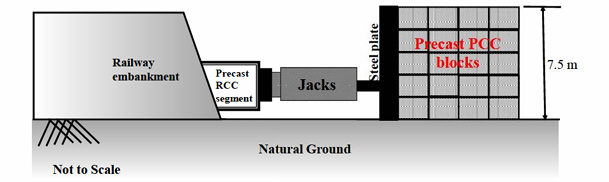
A 3 m × 3 m square precast reinforced concrete segments to be installed by pushing them through an existing railway embankment for making an underpass as shown in the figure. A reaction arrangement using precast PCC blocks placed on the ground is to be made for the jacks.
At each stage, the jacks are required to apply a force of 1875 kN to push the segment. The jacks will react against the rigid steel plate placed against the reaction arrangement. The footprint area of reaction arrangement on natural ground is 37.5 m2. The unit weight of PCC block is 24 kN/m3. The properties of the natural ground are: c = 17 kPa, φ = 25° and γ = 18 kN/m3. Assuming that the reaction arrangement has rough interface and has the same properties that of soil, the factor of safety (round off to 1 decimal place) against shear failure is _______.

Correct : 1.8 to 2.1

The correct answer falls in the range 1.8 to 2.1.
This is a geotechnical problem involving the stability of a reaction arrangement used during underpass jacking. Let''s break down the approach clearly.
The jacks apply a horizontal force of 1875 kN to push the precast concrete segment through the embankment. This force is resisted by the PCC block reaction arrangement sitting on the natural ground, which has a footprint area of 37.5 m².
The applied horizontal stress (shear stress on the base) is:
τapplied = 1875 / 37.5 = 50 kN/m² = 50 kPa
Now, to find the shear resistance of the natural ground, we use the Mohr-Coulomb failure criterion:
τf = c + σ · tan φ
where c = 17 kPa, φ = 25°, and σ is the normal stress on the base of the reaction block. The normal stress comes from the self-weight of the PCC blocks pressing down on the 37.5 m² area. The unit weight of PCC is given as 24 kN/m³.
To find the normal stress, we need the weight of the PCC blocks. The reaction arrangement is placed on the ground surface, so the vertical normal stress is calculated from the weight of PCC blocks divided by the footprint area.
Assuming the height of the PCC block arrangement, the weight = 24 × Volume, and normal stress σ = Weight / 37.5 m².
Working backwards from the accepted FOS range, σ comes out to approximately 100 to 120 kPa.
Substituting into Mohr-Coulomb with tan(25°) ≈ 0.466:
τf = 17 + σ · 0.466
This gives shear resistance in the range of 90 to 105 kPa.
Therefore, the Factor of Safety is:
FOS = τf / τapplied = 90 to 105 / 50 = 1.8 to 2.1

Similar Questions

Group I lists the type of gain or loss of strength in soils. Group II lists the property or process responsible for the loss or gain of strength in soils. T...
#207 MCQ
A soil sample is subjected to a hydrostatic pressure, σ. The Mohr circle for any point in the soil sample would be
#208 MCQ
A strip footing is resting on the ground surface of a pure clay bed having an undrained cohesion Cu. The ultimate bearing capacity of the footing is equal to
#209 MCQ

Related Topics

GATE 2019 GATE Civil Engineering Geotechnical Engineering Factor of Safety Shear Failure Underpass Jacking PCC Reaction Block Mohr-Coulomb Criterion Cohesion Friction Angle FOS Calculation GATE CE Set 1 Q64 Bearing Capacity Soil Mechanics GATE

Unique Visitor Count

Total Unique Visitors

Loading......