Chemical Engineering > GATE 2020 > Liquid-Liquid Extraction
Two ideal cross-current stages operate to extract P from a feed containing P and Q. as shown below.
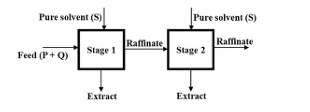 The mass flow rates of P and Q fed to Stage 1 are 1,000 kg h-1 and 10,000 kg h-1 respectively. Pure solvent (S) is injected at mass flow rates of 5,000 kg h-1 and 15,000 kg h-1 to Stages 1 and 2, respectively. The components Q and S are immiscible. The equilibrium relation is given by Y*=1.5X, where X is the mass of P per unit mass of Q in the raffinate, and Y* the mass of P per unit mass of S in the extract, which is in equilibrium with the raffinate. The mass flow rate of P (in kg h-1) in the raffinate from Stage 2 is _______ (round off to nearest integer).
Correct : 176
Similar Questions
100 kg of a feed containing 50 wt.% of a solute C is contacted with 80 kg of a solvent containing 0.5 wt.% of C in a mixer-settler unit. From this operation, th...
A multi-stage, counter-current liquid-liquid extractor is used to separate solute C from a binary mixture (F) of A and C using solvent B. Pure solvent B is reco...
It is decided to extract A from a feed containing 20 mol% A and 80 mol% B in two ideal cross-current stages as shown below, using equal amount of pure solvent C...

Total Unique Visitors
Loading......