Biomedical Engineering > GATE 2026 > Biomechanics of Musculoskeletal System
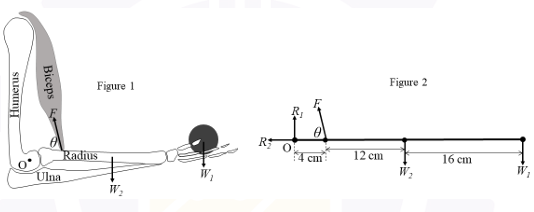
Figure 1 depicts an arm holding a ball in static equilibrium. Figure 2 shows the free-body diagram of the lower arm where F is the force applied by the biceps muscle at an angle of θ = 60 degrees with respect to the lower arm, and R1 and R2 are the reaction forces acting at point O. The weights of the ball and the lower arm are W1 = 50 Newtons (N) and W2 = 20 N, respectively. The force exerted by the biceps muscle is F = __________ N. (Round off to the nearest integer). Assume the lower arm to be a rigid body.
Correct : 554
Similar Questions
You should _________ when to say _________.
Two straight lines pass through the origin (x0, y0) = (0,0). One of them passes
through the point (x1, y1) = (1,3) and the other passes through the point
(x2,...
If
p ∶ q = 1 ∶ 2
q ∶ r = 4 ∶ 3
r ∶ s = 4 ∶ 5
and u is 50% more than s, what is the ratio p ∶ u?

Total Unique Visitors
Loading......